AnnaMaria
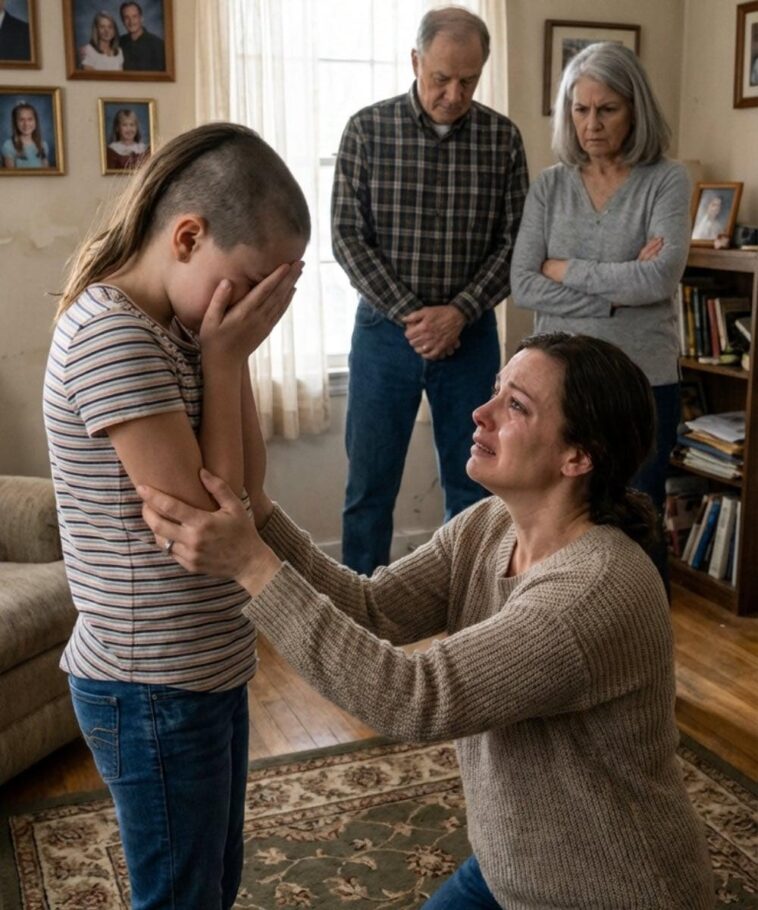
That morning, I kissed my eight-year-old daughter, Lucía, on the forehead, reminding her as always to be kind and brave. I left her with her grandmother, Carmen—her father’s mother—without a hint that this day would change everything.
Lucía’s hair was long, thick, and dark—reaching her waist. To her, it wasn’t just beauty; it was safety, control, and comfort in a loud world. Every night she brushed it meticulously, strand by strand, as if weaving order from chaos.
That illusion of safety shattered the moment I returned home.
The Shock
The house was silent—not peaceful, but hollow. Lucía sat perfectly still, eyes fixed on a blank wall. She didn’t smile, didn’t run into my arms.
And then I saw it. Her hair was gone.
Shaved. Brutally. Unevenly. With patches of raw scalp showing through.
From the kitchen, Carmen’s calm voice floated:
“It was to teach her humility. Girls shouldn’t draw attention to themselves.”
Lucía didn’t cry. That silence—so absolute—was what terrified me most.
When Protection Fails
My husband Javier arrived minutes later. His mother explained. Rationalized. Used words like discipline and tradition.
I waited for him to stand between our daughter and cruelty. He looked down.
“It’s not that serious. Hair grows back.”
Something inside me broke.
That night, Lucía didn’t eat. She crawled into bed still wearing her clothes, clutching her doll as if it were the only anchor left. I held her until her breathing slowed, hands trembling.
I didn’t argue with Carmen. I didn’t yell. I understood one truth clearly: fighting words wouldn’t save my daughter. Action would.
Legal Action: Boundaries Must Be Set
The next day, I sent Lucía to school wearing a soft knit hat. The principal noticed immediately, asked questions, documented, and activated protocol.
We went straight to a child psychologist. Lucía drew a picture: a tiny figure next to an enormous shadow. The doctor didn’t hesitate: “Severe emotional trauma.”
That same week, I filed a formal complaint. Not for revenge—for protection.
The lawyer was clear: shaving a child’s hair as punishment is psychological abuse. Allowing it unchecked is also a choice.
The Court Hearing
At the hearing, Carmen arrived confident, rosary in hand, speaking about “proper upbringing.”
When it was my turn, I presented evidence:
-
School reports
-
Psychological evaluations
-
Messages criticizing Lucía’s body and worth
The courtroom went silent. The judge turned to Javier:
“Joint custody requires active protection. Allowing abuse is participation.”
He had two choices: remain under his mother’s control and lose daily access or establish immediate boundaries protecting Lucía.
Javier broke down. For the first time, he didn’t look away.
“Not choosing,” the judge said, “is also choosing.”
Lucía finally had someone willing to stand up for her.
The Healing Begins
Lucía wasn’t celebrating. She hugged me tightly, as if she could finally breathe. The house felt different—not empty, but a space for recovery.
The months that followed were slow. Lucía began speaking again, first at home, then at school. Her hair grew back, but more importantly, she learned that her body belongs to her.
Javier attended mandatory family therapy. He learned, painfully, that being a father doesn’t mean remaining neutral. Our relationship changed. There was no romantic reconciliation—but there was a clear agreement: Lucía always comes first.
A Lesson in Listening
Sometimes, protecting a child means going deep, not far. Lucía’s silence that day was the clearest message I’ve ever received: if I didn’t speak for her, no one would.
Now, when she looks in the mirror, she sees growth, not punishment. She knows: no one has the right to humiliate her “for her own good.”
Why This Matters
Many families normalize minor abuse until it leaves deep wounds. If something resonates with you, don’t minimize it. Listen to children. Observe the silence. Act in time.
Because silence never protects.