AnnaMaria
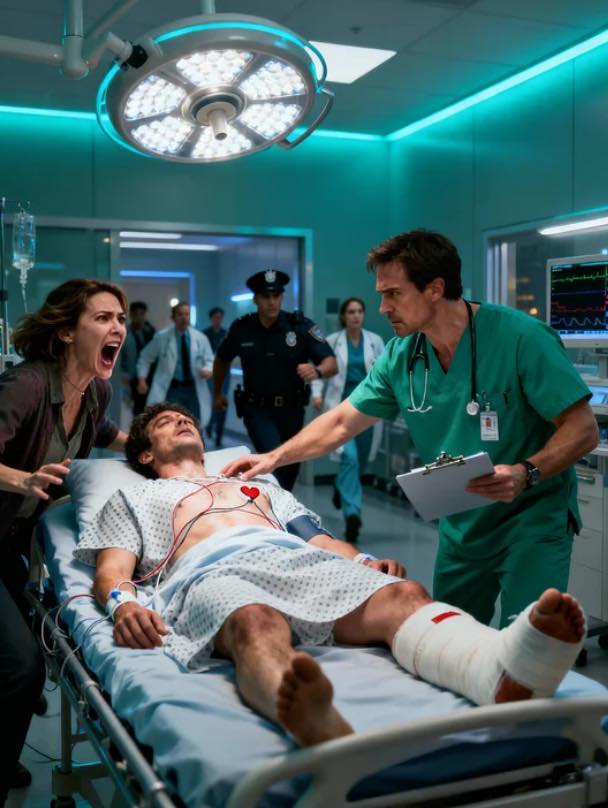
I went to the hospital to care for my husband, Mark, who had a broken bone. While he slept, the head nurse slipped a folded piece of paper into my hand. It read:
“Don’t come back. Check the camera.”
My stomach clenched. I didn’t ask questions—I couldn’t. I just stared at Mark’s motionless face, listening to the beeps of the monitors and the distant shuffle of feet in the hallway, fingers crushing the note.
What camera? Why us? Why would the head nurse warn me like that?
Mark had fractured his ankle at a construction site. The ER smelled of disinfectant and burnt coffee. Pale and doped on painkillers, he tried to joke through clenched teeth as staff prepped him for imaging and a temporary splint.
By the time they took him upstairs, it was past midnight. The orthopedic floor was quieter, but far from calm. Monitors beeped irregularly. The air felt too cold. Nurses moved quickly, rarely holding eye contact.
I sat beside Mark’s bed, scrolling my phone with one hand, holding his warm fingers with the other. He fell asleep.
Around 2:10 a.m., a woman entered with a posture that made everyone straighten. Her badge read: “Head Nurse: Dana Whitmore.” She didn’t smile. She checked Mark’s chart, adjusted the IV, and scanned the room as if counting exits.
Then she stepped close—too close—and slipped the folded paper into my palm like contraband.
“Don’t open that here,” she murmured. Eyes fixed on the door window. “And… don’t come back.”
Before I could speak, she was gone. The door clicked softly behind her.
My heart pounded. I stared at the paper against my skin. Edges damp with sweat. For a full minute, I didn’t unfold it. I listened to the distant squeak of a cart, a brief laugh down the hall, a machine alarm quickly silenced.
Finally, I unfolded it:
DON’T COME BACK. CHECK THE CAMERA.
No signature. No explanation.
I looked at Mark. Still asleep. I glanced at the ceiling corner—where a small black dome camera sat above the room number sign. Not blinking. Not obvious. But there it was.
My instincts screamed. My first thought was to ignore it. My second—stronger—was to find out what Dana thought I needed to see.
I stepped carefully into the hallway. Near the nurses’ station, Dana was watching the monitors. She caught my gaze and lifted her chin slightly toward the screens—a silent warning.
And then one of the screens flickered.
I saw myself on camera… standing beside Mark’s bed.
But there was someone else in the room.
The timestamp read 1:47 a.m.—twenty minutes before Dana had appeared. Behind me, near the cabinet with gloves and linens, stood a man half-hidden in shadow.
Hospital scrubs. Surgical cap. Too still. Patient. Waiting.
He wasn’t looking at Mark. He was looking at me.
Dana moved fast. She didn’t grab me, but she positioned herself so her body blocked the monitor from anyone else.
“You saw him,” she said, barely moving her lips.
“Who is he?” My voice was small, almost childish.
“It’s not personal. Not tonight,” she said.
“Call security,” I whispered.
“We did,” she replied, eyes scanning the hallway. “They didn’t see him the first time. We don’t know how he got onto the floor.”
“The first time?”
“Two other families reported someone in the room this week. One thought it was a confused patient. The other thought it was cleaning staff. But cameras don’t lie.”
I gripped the counter. “Why didn’t anyone tell us?”
“Administration doesn’t like panic,” she said. “Security calls it ‘access control,’ ‘badge issues,’ or ‘staff shortages.’ Meanwhile, he keeps getting in.”
My mind raced: theft, assault, medical fraud. The thought of him watching me—so focused, so silent—made my throat knot.
“He targets caregivers,” Dana said. “People who stay overnight. He learns routines. When nurses make rounds. When partners step out for coffee.”
“Then why are we still here?”
“Because your husband needs surgery. And because you won’t be alone in that room anymore.”
She handed me a small visitor badge clip. Normal-looking, but heavy in my hand.
“If you leave, record on your phone. Ask anyone who enters their name and badge—no exceptions. Don’t let anyone separate you from your husband.”
The next hour was a test of endurance. Mark slept. I stared at the cabinet like it might move. My phone storage flashed warnings, but I kept recording.
At 3:26 a.m., the door handle moved.
A man entered wearing scrubs and a surgical cap. Mask lowered. Clipboard in hand. Confidence radiating.
I sat up. “Can I help you?”
He didn’t flinch. “I’m here to check the chart.”
“Name?” My voice was louder.
He paused. “It’s late. I don’t need—”
“I need your name. And your badge.”
He stepped toward Mark’s wristband.
I jumped, chair scraping. “DON’T TOUCH HIM!”
Footsteps rushed in—Eric, Dana, two security guards. The man froze, clipboard cracking against the floor. Dana’s voice, cold and steady: “I’ve got you.”
They escorted him away while I stood shaking, phone still recording. Mark woke fully, confused.
Later, I told him the truth—carefully, plainly, without drama. Just facts.
If Dana hadn’t given me that note, I might have ignored my instincts. I might have left Mark alone.
Sometimes a stranger’s warning is the difference between routine and disaster.
Would you have checked the camera—or trusted the hospital and walked away?