AnnaMaria
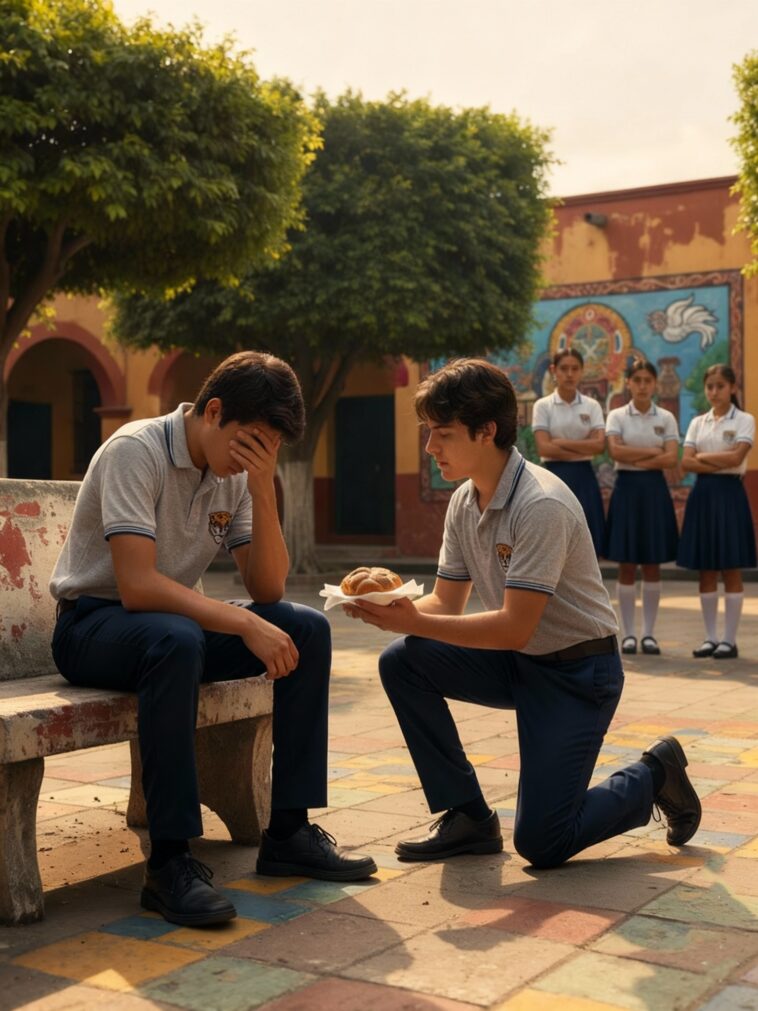
I used to steal the poor boy’s lunch just to laugh at him every day. Until a note hidden by his mother turned every bite into guilt and ashes.
I was the terror of the school. That’s not an exaggeration—it’s the truth. When I walked down the hallways, younger kids lowered their heads, and teachers pretended not to notice. My name is Sebastián. Only child. My father was an influential politician—the kind who smiles on TV while talking about “equal opportunities.” My mother owned a chain of luxury spas. We lived in a mansion so large that silence echoed through its corridors.
I had everything a boy my age could want: the most expensive sneakers, the latest iPhone, brand-name clothes, a credit card that seemed to have no limit. But I carried something invisible too: a dense, heavy loneliness that followed me even when I was surrounded by people.
At school, my power rested on fear. And like every coward who wields power, I needed a victim.
Tomás was that victim.
He was the scholarship student. Always at the back of the classroom, uniform handed down from some distant cousin, shoulders hunched, eyes glued to the floor as if apologizing for existing. He carried his lunch in a wrinkled brown paper bag, stained with grease from simple, repetitive meals. To me, he was perfect.
Every day at recess, I repeated the same “joke.” I’d snatch the bag from his hands, climb onto a table, and shout for everyone to hear:
“Let’s see what trash the neighborhood prince brought today!”
Laughter exploded like fireworks. Tomás never fought back. He didn’t shout. He didn’t push. He just stood there, motionless, eyes shiny and red, silently begging for it to end quickly. I would pull out his food—sometimes a bruised banana, sometimes cold rice—and toss it in the trash as if it were contaminated.
Then I’d go to the cafeteria and buy pizza, burgers—whatever I felt like—paying with my card without even glancing at the price. I never thought it was cruelty. To me, it was fun.
Until that gray Tuesday.
The sky was overcast, the air chilly. Something felt different, but I ignored it. Tomás’ bag looked smaller. Lighter.
“What happened?” I asked with a crooked smile. “Run out of money for rice?”
For the first time, Tomás tried to take the bag back.
“Please, Sebastián,” he said, voice breaking. “Give it back. Not today.”
That plea awakened something dark inside me. Power. Control.
I opened the bag in front of everyone. No food fell out. Only a piece of hard bread, and a small folded note.
I laughed loudly. “Look at this! Stone bread! Careful you don’t break your teeth!”
The laughter started—but something didn’t fit.
I bent down, picked up the note, thinking it would be meaningless. I read aloud, exaggerating every word:
“My son:
Forgive me. Today I couldn’t get money for cheese or margarine. This morning I didn’t eat breakfast so you could take this piece of bread with you. It’s all we have until Friday. Eat slowly to trick the hunger. Study hard. You are my pride and my hope.
Loves you with all her soul,
Mom.”
My voice faded with each line. The courtyard fell silent, as if the world had stopped breathing.
I looked at Tomás. He was crying silently, covering his face—not from sadness, but shame.
That bread wasn’t trash. It was his mother’s breakfast. Hunger turned into love.
For the first time in my life, something inside me broke.
I thought about my own lunchbox—Italian leather, full of gourmet sandwiches, imported juices, expensive chocolates. I hadn’t even noticed its contents for days. My mother never asked how school was anymore.
I had a full body, but an empty heart. Tomás had an empty stomach, but his heart was full of love.
I walked over. Everyone expected another humiliation. But I knelt down, picked up the bread carefully as if it were sacred, and placed it in his hand along with the note. Then I set my lunch on his lap.
“Trade lunches with me, Tomás,” I said, voice breaking. “Please. Your bread is worth more than everything I have.”
I didn’t know if he would forgive me. I didn’t know if I deserved it. I sat beside him. That day I didn’t eat pizza. I ate humility.
The days that followed were different. I didn’t become a hero overnight. Guilt doesn’t disappear that easily. But something had changed. I stopped mocking. I started observing.
I discovered that Tomás got good grades not because he wanted to be the best, but because he felt he owed it to his mother. I discovered he walked with his eyes on the ground because he had learned to ask the world for permission.
One Friday, I asked if I could meet his mother. She welcomed me with a tired smile, hands rough, eyes full of tenderness. When she offered me coffee, I knew it was probably the only hot thing she had that day.
That day I learned what no one had ever taught me:
Wealth isn’t measured in things.
It’s measured in sacrifices.
I promised that as long as I had money, that woman would never go without breakfast again. And I kept my promise.
Because some people teach you lessons without raising their voice.
And some pieces of bread weigh more than all the gold in the world.