AnnaMaria
There are moments in life that divide time into before and after.
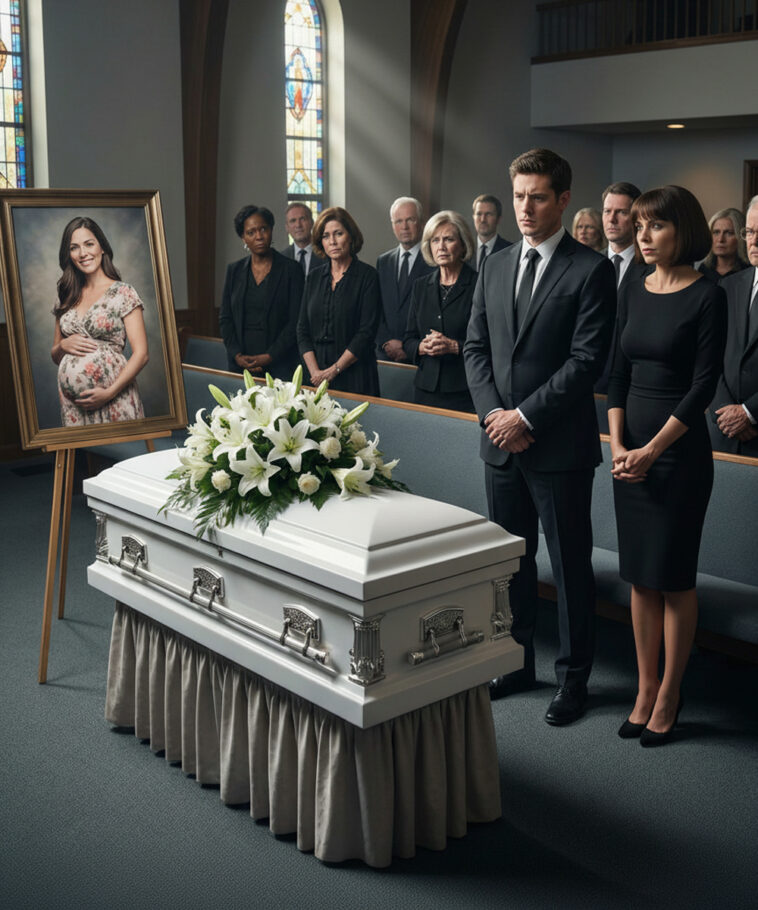
For me, it was the moment my brother-in-law walked into my sister’s funeral with another woman on his arm.
From that instant on, nothing about Lily’s death felt accidental anymore.
A Funeral That Felt Wrong From the Start
My name is Emily Carter, and I still remember the weight of the air inside that church as if it were pressing down on my lungs.
White lilies lined the aisle, their sweet scent mixing with hushed prayers and restrained grief. At the front rested my sister Lily’s closed casket. She had been thirty-two weeks pregnant when she died. The official report said she fell down the stairs.
Jason—her husband—said it was a tragic accident.
I never believed him.
My sister was careful. Protective. Especially after becoming pregnant. And in the weeks before her death, she had grown quieter, more guarded. Something had been wrong long before her body hit those stairs.
When He Walked In With Her
The heavy wooden doors creaked open mid-service.
Jason entered wearing a black suit and an expression so rehearsed it looked borrowed. But what froze the entire room wasn’t him—it was the woman attached to his arm.
Tall. Brunette. Perfectly styled. Dressed in fitted black as though she belonged there.
My mother’s nails dug into my hand.
“Is he serious?” she whispered.
I recognized her instantly.
“That’s Rachel,” I said under my breath. The so-called coworker whose name had appeared on Lily’s phone months earlier. The one Lily swore was “nothing,” right before she stopped smiling the same way.
Jason guided Rachel to the front row. My sister’s row. He let her lean into him, playing the role of grieving partner as if Lily had never existed.
My chest burned with rage.
I started to stand, ready to drag her out myself, but my father pulled me back.
“Not here,” he said quietly. “Not today.”
The Service for a Woman Who Never Got Justice
The pastor spoke of Lily’s kindness, her laugh, her love for the baby boy she had already named Noah. People dabbed their eyes. Some glanced at Jason with sympathy.
I couldn’t stop staring at him.
How does a man mourn his wife while holding the woman who helped destroy her marriage?
As the final hymn faded and people rose from their seats, a man in a gray suit stepped forward, carrying a leather briefcase. He was calm, deliberate, and completely out of place among the grief.
“Excuse me,” he said, his voice carrying through the church. “My name is Daniel Hayes. I am Lily Reed’s attorney.”
The Will She Insisted Be Read at Her Funeral
Jason stiffened immediately.
“Now?” he snapped. “You’re doing this now?”
Mr. Hayes didn’t blink.
“Your wife left explicit legal instructions,” he said evenly. “Her will is to be opened today, in front of her family—and in front of you.”
A ripple of confusion spread through the pews. Funerals weren’t the place for legal matters. But Lily had never been careless. If she planned this, she had a reason.
“There is a section,” Mr. Hayes continued, “that Lily insisted be read aloud at her funeral.”
He unfolded a single page, creased and worn. I recognized her handwriting instantly.
“This is a personal statement Lily attached to her will,” he said. “Written three weeks before her death.”
Jason shifted. Rachel tightened her grip on his arm.
Then the lawyer began to read.
“Jason, I Know About Rachel”
“If you are hearing this, I am no longer here,” the letter began.
“Jason, I know about Rachel. I’ve known far longer than you think.”
Gasps rippled through the church.
My mother covered her mouth. Jason went rigid.
“I tried to forgive you for our baby’s sake,” the letter continued, “but every lie, every late night, chipped away at me until something inside broke. That is why I changed my will.”
The room was silent now. Phones appeared discreetly in hands. No one looked away.
The Inheritance He Expected — and Didn’t Get
“To my husband, Jason Reed,” Mr. Hayes read, “I leave nothing beyond what the law requires. You may keep your personal items and the vehicle in your name. That is all. You have already taken enough from me.”
Jason jumped to his feet.
“This is fake!” he shouted. “She didn’t write that!”
Rachel whispered frantically for him to sit down as murmurs turned into outright shock.
Mr. Hayes’ voice hardened.
“Sit down, Mr. Reed. There is more.”
The Trust That Changed Everything
“Lily’s estate,” he continued, “including the home, savings, and life insurance benefits, is to be placed in a trust for our unborn son, Noah.”
My knees nearly buckled.
“If Noah does not survive,” he read on, “the trust will pass to my sister, Emily Carter, who will decide how best to honor my memory.”
Jason laughed bitterly.
“Emily?” he scoffed. “She can’t even manage her own bills.”
Mr. Hayes looked at him coldly.
“This will was reviewed, notarized, and legally binding. Your opinion is irrelevant.”
The Envelope Lily Prepared “Just in Case”
Then the lawyer reached into his briefcase again.
“This envelope,” he said, holding it up, “was delivered to my office two days before Lily’s death. It is marked in her handwriting: ‘To be opened only if my death is ruled an accident.’”
The church went completely still.
Jason’s face drained of color.
Mr. Hayes opened the envelope and read.
“If Jason claims I fell, please do not accept it without question,” Lily wrote. “On March 5th, after I confronted him about Rachel, he grabbed my arm hard enough to bruise it and said, ‘If you destroy my life, I’ll destroy yours.’ I no longer feel safe in my own home.”
My stomach twisted.
“I installed a small security camera at the top of the stairs,” the letter continued. “If something happens to me, my lawyer has instructions.”
Mr. Hayes placed a small black flash drive on the podium.
“This contains the footage Lily sent to my office the night before she died.”
When an “Accident” Became a Criminal Case
Two weeks later, we sat in a cramped police interview room.
A laptop sat open in front of us.
The footage was grainy—but unmistakable.
Lily stood at the top of the staircase, eight months pregnant, crying, phone in hand. Jason was below her, yelling.
“You’re not leaving!” his voice thundered. “You’re not taking my son!”
“He’s not your possession!” Lily cried. “I’m going to my parents—”
Jason rushed upward. Grabbed her wrist. She tried to pull away.
Then he shoved.
We watched her fall.
My mother collapsed into my father. I couldn’t breathe.
The detective paused the video.
“This is not an accident,” he said quietly. “This is manslaughter.”
Arrest, Arraignment, and Accountability
Jason was arrested within days—charged with manslaughter, domestic abuse, and obstruction. The media called it the staircase tragedy. Rachel disappeared overnight, deleting every account like she’d never existed.
At the arraignment, Jason shuffled in wearing an orange jumpsuit and shackles. He looked small. Powerless.
As he passed me, he whispered, “Emily… tell them I didn’t mean—”
I stood.
“You brought your mistress to my sister’s funeral,” I said. “You meant every part of this.”
He looked away.
Turning Loss Into Purpose
When the trust was finalized, there was no child to inherit it. Everything passed to me, exactly as Lily planned.
It didn’t feel like money.
It felt like responsibility.
I moved into Lily’s house. I repainted the stairwell. Installed better lighting. And I transformed the unused nursery into a safe space—where women dealing with domestic violence, legal uncertainty, and financial control could come for help.
Sometimes, I sit at the kitchen table with Lily’s letter spread out before me.
She wasn’t just writing a will.
She was building protection.
She was planning insurance against silence.
She was making sure the truth would survive—even if she didn’t.
As you were.