AnnaMaria
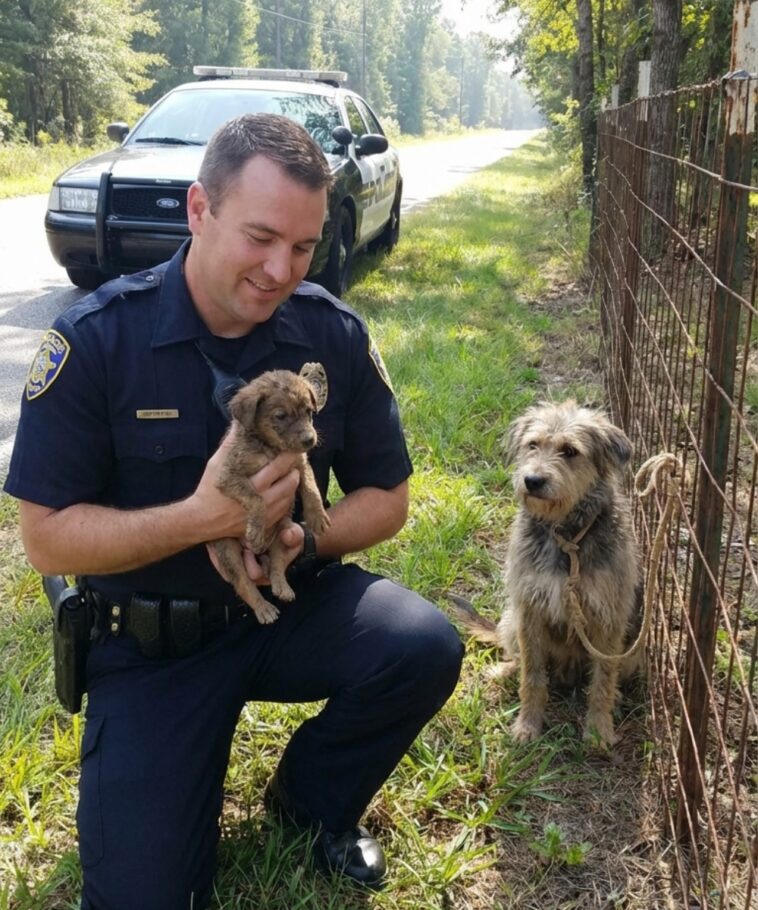
There are moments from the job that don’t fade with time.
This is one of them.
I’m a police officer in a small town where emergencies usually whisper instead of scream. Most days are predictable—traffic stops, paperwork, quiet welfare checks. That morning, I expected nothing different.
I was wrong.
The mountain road was almost empty, wrapped in dull gray light. As I rounded a sharp curve, I noticed something pale near the shoulder. At first, I thought it was trash caught by the wind.
Then it moved.
A tiny puppy staggered into the road.
I hit the brakes.
It didn’t bark. It didn’t run. It stood there—skinny, dirty, ribs visible beneath its fur—and looked straight at me. Not with fear. With urgency.
I’ve seen animals beg for food. I’ve seen them beg for kindness.
This one was begging for time.
I stepped out slowly, hand low, voice calm. The puppy didn’t retreat. Instead, it turned toward the trees and took a few steps—then looked back.
As if to say: Come.
I followed.
It led me off the road, stopping every few steps to make sure I was still behind it. That’s when I noticed the smell—heated plastic—and the scattered debris in a small clearing.
Then I saw it.
A large plastic storage container, half-hidden in brush, tipped on its side. The lid was jammed shut.
From inside came a sound I’ll never forget.
A faint, broken whimper.
I crouched and looked inside.
There was a dog. The puppy’s mother. Trapped. Dehydrated. Barely moving.
Reality hit all at once. She couldn’t escape. The air inside was stale. The heat was rising. And that puppy—barely more than a baby—had gone searching for help on its own.
I radioed for assistance and ran back to the car for a pry tool. My hands were shaking, not from fear, but from the terror of being too late.
When I forced the lid open, hot air rushed out. The mother tried to stand and collapsed. I lifted her carefully, supporting her weight. She was frighteningly light.
The puppy rushed to her side, licking her face, whining—not for attention, but for life.
My partner arrived moments later. He didn’t say a word. He didn’t need to.
We gave the mother small sips of water and called a rescue and a vet. While we waited, the puppy stayed pressed against her neck, nudging her every time her eyes closed.
At one point, a car slowed on the road nearby… then drove on.
The puppy lifted its head.
I realized then that it had probably tried to stop others before me.
That thought hurt more than I expected.
At the vet, we were told the truth plainly: severe dehydration, stress, infection. She had a chance—but nothing was guaranteed.
The puppy slept in bursts, waking every time his mother shifted. Exhausted. Still on guard.
By morning, she opened her eyes more clearly. When she saw him, she rested her head against his body. The sound he made then wasn’t a bark or a cry—it was pure relief.
I stepped away so no one would see my eyes burn.
Over the next few days, the town quietly rallied. Blankets appeared. Food. A temporary shelter. No speeches—just action.
Recovery wasn’t dramatic. It was slow. Uneven. Real.
But the puppy never left her side. Every time she struggled, he pushed closer, as if reminding her why she had to keep going.
Eventually, the call came: she was standing.
Then came the part that still feels unreal.
They were adopted. Together.
People wanted the puppy. But he refused to be separated from his mother. So the rescue insisted—one home, both lives.
A young couple met them. The mother approached cautiously. The puppy ran ahead, then stopped and looked back—waiting for her.
When she relaxed, he relaxed.
Before leaving, the couple asked for a photo with us.
I almost corrected them.
Because the hero wasn’t wearing a badge.
The hero was small enough to fit under a boot—and brave enough to stop a police car on a dangerous curve to save the only life that mattered to him.
I went back to work. Back to routine.
But something changed.
I look at roadsides differently now. At discarded containers. At animals who don’t look away—but look at you.
Because sometimes, changing the world isn’t big.
Sometimes it’s just stopping.
Looking.
And listening when a life asks for help.
If this story stayed with you, let it do more than make you feel something. Carry water. Save a shelter number. Don’t assume someone else will stop.
Because some lives depend on a single brake.
And some hearts—like that puppy’s—are powerful enough to remind us what being human still means.
There it is.