AnnaMaria
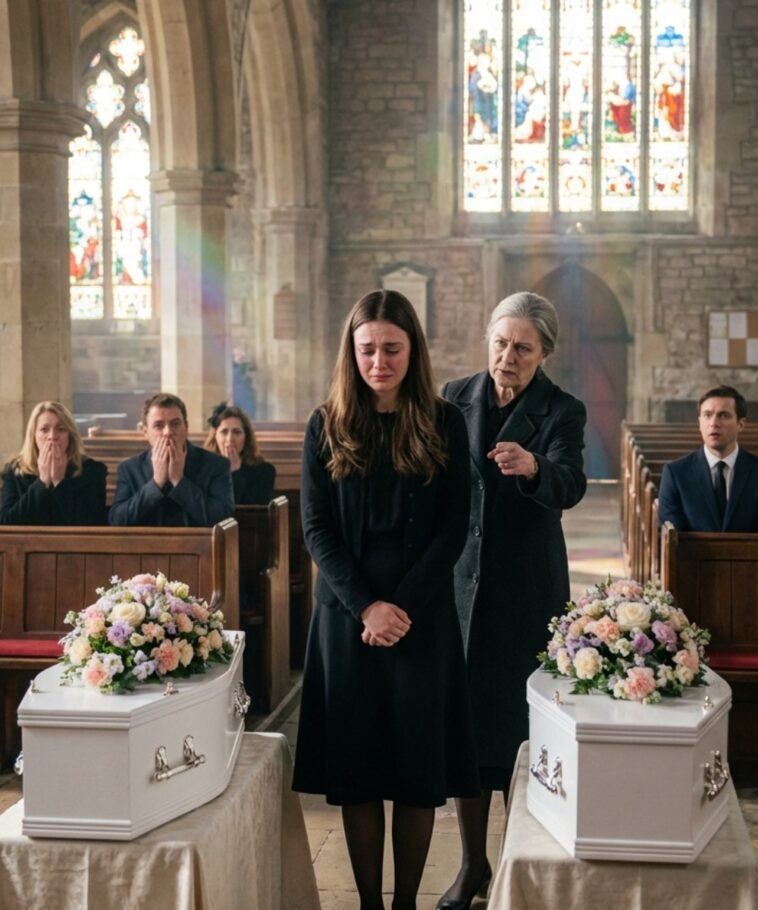
The morning my twins were laid to rest arrived under a sky weighed down by clouds, as if the world itself had chosen to grieve with me.
Two small white coffins rested before the altar—so impossibly small that my mind refused to accept they were real. My name is Lucía Herrera, and I still could not comprehend that my sons—Mateo and Daniel—were gone. Only three weeks earlier, I had felt them moving inside me. Now there was only an unbearable void where life had been.
People offered hushed condolences that slid past without meaning. My husband, Álvaro, stood at my side, stiff and distant, eyes unfocused. Since the babies died during childbirth, he seemed hollowed out, as if sorrow had emptied him entirely. I felt the opposite—every emotion struck me with full force, sharp and relentless.
Then I felt a breath warm against my ear. It was Carmen, my mother-in-law. She leaned close, her lips curling into a twisted smile, and whispered with quiet cruelty:
“God took them because He knew what kind of mother you were.”
Something shattered inside me. Tears I had been restraining spilled over, and I begged,
“Please… can you be silent—just today?”
The Slap That Echoed Through the Sanctuary
The church went utterly still. Carmen’s eyes burned with rage. In an instant, her hand lashed out. The slap echoed across the sanctuary. Before I could regain balance, she shoved me forward, and my forehead struck one of the coffins. Pain exploded through my head, mixing violently with grief.
She leaned in again, close enough to smell her sharp perfume, and hissed:
“Be quiet—or you’ll end up with them.”
Gasps erupted. My knees gave out. I collapsed, blood running down my brow. Álvaro didn’t move or speak—he simply stared, paralyzed.
That was when a steady voice cut through the chaos.
“That’s enough!”
A Voice of Justice
Every head turned. It was Isabel, Álvaro’s older sister, known for her restraint. She moved swiftly down the aisle, face pale, eyes blazing. She stood between Carmen and me like a barrier.
“Mom,” she said, “you crossed a line that can never be undone. And this didn’t start today.”
Carmen tried to respond, but Isabel raised her hand, stopped her, and pressed play on her phone. The church filled with a recorded voice—Carmen’s, dismissing my pregnancy symptoms, telling me I was “overreacting,” insisting I didn’t need rest. I remembered ignoring doctors’ warnings because of her demands.
“I also have messages where you pressured Lucía not to go to the hospital the night she started bleeding,” Isabel continued.
A wave of shock rippled through the room. Álvaro finally moved, clutching his head, shaking as reality struck him. Carmen’s face drained of color, yet she still tried to deny it. But the silence that followed told a different story.
The priest urged calm, and people came to help me. A woman called an ambulance. For the first time since my children’s deaths, I felt someone was truly on my side.
The Road Ahead
Álvaro whispered, tears in his eyes, “Forgive me… I didn’t want to see what was happening.”
The damage, however, was done. Not only had I lost my children, but I had also lost faith in the man who was supposed to protect us. Carmen was escorted out of the church, her image as a devoted mother crumbling in minutes.
Months passed. My forehead healed, but the invisible scars took longer. With Isabel’s support, I reported Carmen. Reliving the events in court was painful, but I owed it to Mateo and Daniel. Justice wouldn’t bring them back, but it set a clear boundary.
Álvaro and I tried therapy, but the distance was too great. He admitted he had failed, minimizing his mother’s abuse for years. With heavy hearts, we decided to separate.
I moved to another city and started over. I went back to work, met new people, and little by little, learned to live with their absence. Every birthday, I light two candles and talk to my children in silence—not from guilt, but from love.
Carmen was convicted of assault and psychological neglect. She never showed remorse—but that no longer mattered. I understood some people don’t change, and my peace was worth more than her forgiveness.
A Lesson in Courage
I share my story not to seek pity, but to remind everyone: abuse—even when disguised as family—must never be tolerated. Pain does not justify cruelty, and silence only protects the abuser.
Lucía’s question remains: Do you think I did the right thing by reporting it and walking away, or would you have acted differently?
Your answer matters—not just for me, but for anyone who may one day need courage to speak out.