AnnaMaria
At my husband’s funeral, his mother looked me straight in the eye and said, coldly,
“It’s better he’s gone than forced to live with the shame she caused him.”
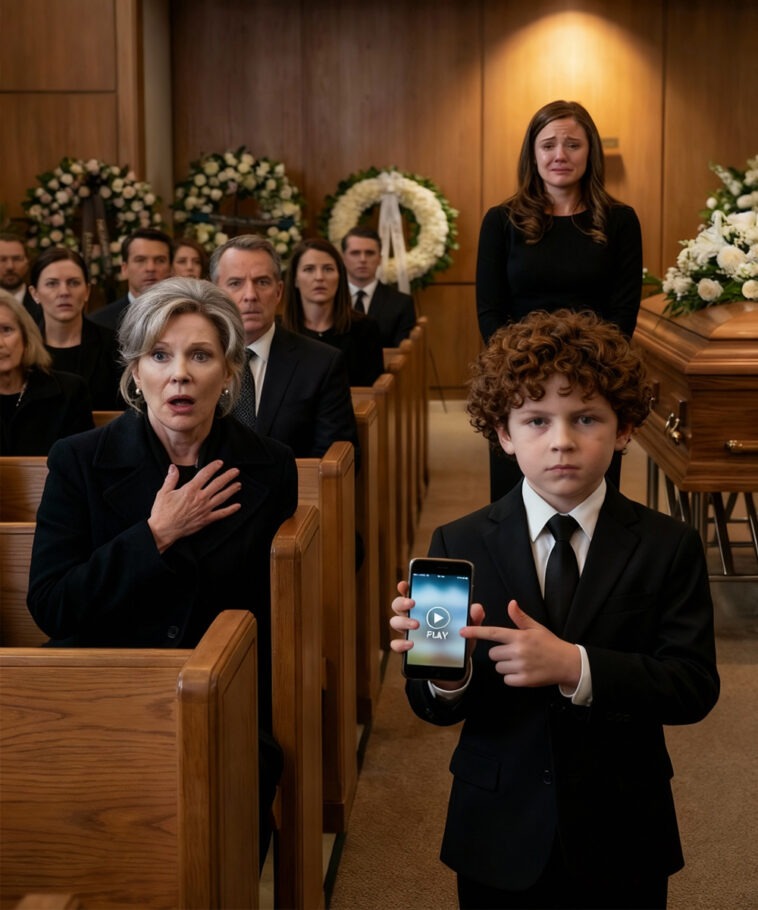
Some relatives murmured in agreement. Before I could find my voice, my eight-year-old son, Evan, stood up, clutching his father’s phone.
“Grandma,” he said evenly, “do you want me to play the message Dad recorded about you last week?”
Her face drained of color. The room fell into stunned silence.
The chapel smelled of lilies and polished wood, a stillness that pressed against my chest. I stood beside Mark’s casket, numb, staring at the closed lid as if it might undo the last seven days. Mark had been steady, unassuming—the man who fixed things quietly and never asked for praise. He was gone at forty-two, and everyone thought they understood him.
Then Diane Carter, his mother, shattered the hush.
“Better he’s gone than forced to live with the embarrassment she brought him,” she repeated. Whispers followed; a cousin nodded, an aunt murmured agreement. My throat tightened. I wanted to speak—to remind them of the late-night hospital runs and extra shifts—but grief locked my words.
Then I felt a small hand on my arm. Evan, my son, stood, black suit slightly oversized, holding Mark’s phone with care. His pale face was calm, focused.
“Grandma,” he said clearly, “do you want me to play the recording Dad made about you last week?”
Diane snapped, “Sit down!” but Evan didn’t. He glanced at me for permission—I nodded. Mark had done nothing without purpose.
“Dad said,” Evan continued, “that if you ever lied about Mom, I should press play.”
He did.
Mark’s voice, steady and familiar, filled the chapel:
“If you’re hearing this, it means my mother finally crossed a line… and I’m done shielding her. My name is Mark Carter. I’m recording this because my mother, Diane, threatened to spread lies about my wife unless I kept paying her bills and covering for her.”
Gasps rippled through the crowd. Diane’s hands shook. Mark calmly detailed the fake loans, credit cards, and money she demanded, complete with dates and screenshots. “I love my mother,” he said softly, “but love doesn’t mean allowing harm.”
Diane lunged toward Evan. “Turn it off!”
The minister stepped in. A cousin restrained her. The recording continued.
“If my son is hearing this,” Mark concluded, “remember: truth isn’t disrespect. It’s protection.”
Silence followed, dense and heavy. Chairs scraped as people quietly left. Some stared at the floor. My sister-in-law whispered, “I didn’t know.”
Diane collapsed into a chair, hollow. “He promised me,” she murmured.
“He promised to protect us,” I said.
In the weeks that followed, Evan asked honest questions, and we gave honest answers. The recording stopped rumors and clarified what had been hidden. Two people requested copies: my sister-in-law and a family friend who gently suggested legal action. Diane avoided us, authority gone.
Grief didn’t vanish—it learned to behave. Some days it was quiet, others loud. But the truth gave us solid ground. Evan, at school, wrote about bravery—not funerals or recordings, but telling the truth when it’s difficult. His teacher emailed: “You’re raising a good man.”
Mark’s voice no longer lives on a phone. It lives in our daily choices.
If you’ve ever been silenced to preserve appearances, remember: telling the truth isn’t betrayal. It’s care with limits—and children understand far more than we think.