AnnaMaria
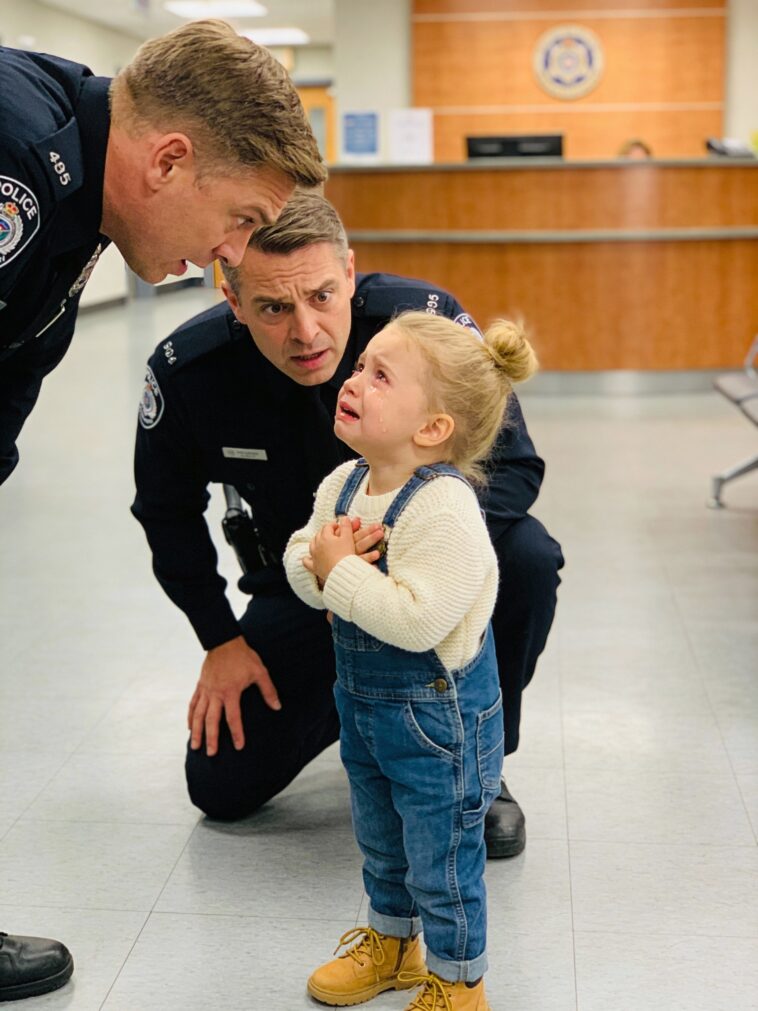
The Visit No One Expected
Police stations see everything: arguments, accidents, paperwork tied to insurance claims, legal disputes, and public safety. Officers are trained to expect adults in distress, not toddlers weighed down by guilt.
That’s why the front desk receptionist froze when a young family walked through the doors that afternoon.
A mother. A father. And between them, a little girl—barely two years old.
Her eyes were swollen from crying. Her cheeks were flushed. She clung to her mother’s hand as if the building itself frightened her. The parents looked exhausted, nervous, and completely out of their depth.
This wasn’t a visit they had planned.
It was one they felt they had no choice but to make.
A Father’s Awkward Request
“Excuse me,” the father said quietly, leaning toward the counter. “Could we see a police officer?”
The receptionist blinked. Families didn’t usually ask that question unless something serious had happened.
“I’m sorry, sir,” he replied carefully. “Why exactly are you here?”
The father straightened his back, clearly uncomfortable.
“This is going to sound strange,” he said, lowering his voice. “But our daughter has been crying nonstop for days. She won’t eat properly. She barely sleeps. She keeps asking to come here—to a police station—to confess a crime.”
The receptionist raised his eyebrows.
“She’s… two,” he said cautiously.
“Yes,” the father nodded. “And we can’t calm her down. She says she did something terrible, but she can’t explain it to us. We don’t know what else to do. We’re embarrassed, but… could an officer spare just a few minutes?”
This wasn’t covered in any manual.
An Officer Steps In
Nearby, a senior sergeant overheard the exchange. He’d spent decades responding to emergencies, handling criminal investigations, and navigating family law and child welfare situations that left lasting impressions.
This, however, was new.
He walked over and crouched down to the child’s level.
“I have a couple of minutes,” he said gently. “Let’s see what’s going on.”
The relief on the parents’ faces was immediate.
“Thank you,” the father said. “Sweetheart, this is the police officer. You wanted to talk to him, remember?”
The little girl studied the man in uniform with deep seriousness, as if evaluating whether he was real.
A Very Serious Question
“Are you really a police officer?” she asked through sniffles.
The sergeant smiled softly and pointed to his uniform.
“I am. See this badge? That means you can tell me the truth.”
She nodded slowly, her lip trembling.
“I… I committed a crime,” she whispered.
The parents inhaled sharply.
The officer stayed calm. Years of experience had taught him that tone mattered more than words—especially with children.
“Okay,” he said evenly. “You can tell me about it.”
She hesitated, then asked the question that revealed just how heavy this was on her small shoulders.
“And… will you put me in jail?”
When Guilt Is Bigger Than Fear
The question landed hard.
This wasn’t a child being dramatic. This was a child who genuinely believed she had done something unforgivable—something that carried real-world consequences like prison and punishment.
“That depends,” the officer said carefully. “Tell me what happened first.”
She clenched her tiny fists, tried to hold herself together, and failed.
Tears poured down her face as she blurted out the confession that stunned everyone within earshot.
“I hit my brother on the leg,” she cried. “Really hard. Now he has a bruise. And he’s going to die. I didn’t mean to. Please don’t put me in jail.”
The words tumbled out in one desperate breath.
Understanding a Child’s Logic
For a moment, the officer was speechless.
He wasn’t shocked by violence—his career had exposed him to far worse. He was shocked by the depth of this child’s fear and responsibility.
In her mind, a bruise meant serious harm. Serious harm meant death. Death meant jail.
Children don’t understand medical realities, personal injury law, or bodily resilience. They understand cause and effect in the simplest terms.
She believed she had ended a life.
The Kindest Part of the Job
The officer’s expression softened immediately. He gently pulled the child into a hug, careful not to overwhelm her.
“No, sweetheart,” he said quietly. “Your brother is not going to die. Nobody dies from a bruise.”
She looked up at him with wet, searching eyes.
“Really?”
“Really,” he nodded. “Bruises hurt, but they heal.”
Her sobs slowed.
“But,” he added gently, “you still shouldn’t hit people. Especially people you love.”
She nodded vigorously.
“I won’t,” she whispered.
“Do you promise?”
“I promise.”
The Calm That Followed
The tension in the room dissolved almost instantly.
The little girl wiped her tears on her sleeve, leaned into her mother, and let out a long sigh—the kind that comes after days of holding something in.
Her parents looked stunned.
For days, they’d worried something was deeply wrong. They’d considered doctors, child psychologists, even early childhood behavioral assessments.
All along, their daughter had been carrying guilt she didn’t know how to release.
What the Officer Knew
As the family prepared to leave, the officer stood and smiled at them.
“She’s empathetic,” he said quietly. “That’s not a bad thing. She just needs help understanding how the world works.”
Children like her don’t need punishment.
They need reassurance, guidance, and safe explanations that fit their age.
In a society obsessed with consequences—legal, financial, and moral—it’s easy to forget that intent and understanding matter.
Especially with children.
A Lesson Bigger Than the Story
By the time the family walked out, the little girl was calm for the first time in days.
The police station returned to its usual rhythm—phones ringing, paperwork moving, officers dealing with matters tied to public safety, insurance documentation, and legal accountability.
But the moment lingered.
A reminder that sometimes the most serious confessions don’t come from hardened criminals or desperate adults.
Sometimes, they come from a toddler who believes she’s done something unforgivable—simply because she cares.
There it is.