AnnaMaria
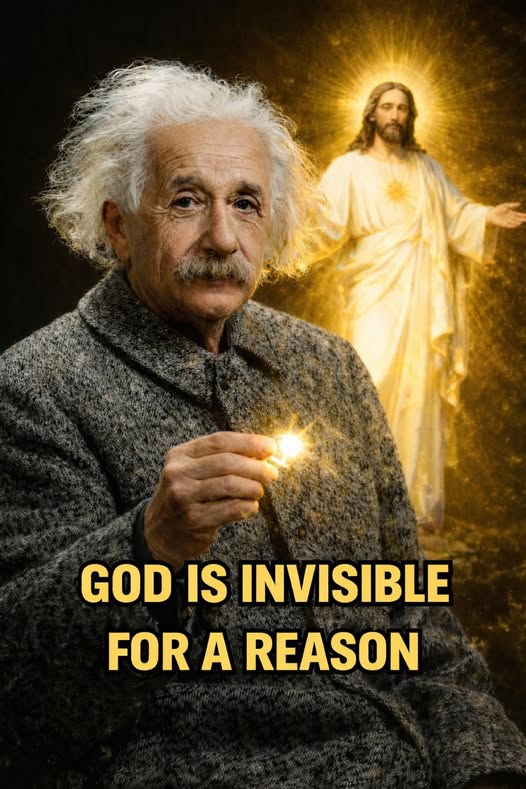
The question feels simple. Almost childlike.
And yet it has followed humanity for as long as we’ve looked at the sky and wondered what lies beyond it.
If God exists, why isn’t He visible?
It’s a question often associated with Albert Einstein — not because he claimed to have the answer, but because he refused to accept shallow ones.
Einstein’s journey from belief to questioning
Einstein grew up in a Jewish household and, as a child, experienced religion with sincere devotion. For a time, faith felt natural and unquestioned.
That changed around the age of twelve.
As he began reading popular science, he encountered a universe far older, larger, and more complex than the literal interpretations he had been taught. His childhood certainty faded — but it wasn’t replaced by emptiness.
Einstein didn’t become a conventional atheist.
Instead, he began searching for a concept of God that did not contradict science, but revealed itself through it.
The God of Spinoza
When asked whether he believed in God, Einstein often referred to the philosopher Baruch Spinoza.
Spinoza’s God was not a personal being who intervenes, judges, or answers prayers.
This God was revealed in the harmony and order of nature itself.
For Einstein, God was not a figure sitting outside the universe.
God was the universe — its laws, its structure, its astonishing mathematical precision.
A universe that isn’t random
Einstein was deeply struck by one fact: reality obeys consistent, universal laws.
Time behaves the same everywhere.
Gravity follows exact rules.
The speed of light does not change.
To him, this coherence was not an accident.
That conviction lives inside his famous line:
“God does not play dice with the universe.”
It was a scientific statement — but also a philosophical one.
Behind appearances, Einstein believed, lies a deep and intelligible order.
Why we can’t “see” God
Einstein often used metaphors instead of doctrine.
One of his most powerful comparisons was this:
Humanity is like a child entering a vast library filled with books written in unknown languages. The child senses order and meaning, but cannot yet understand the system — or its author.
In this view, God is not hidden out of secrecy, but out of scale.
Human perception is limited.
The universe is not.
We may not see God directly, but we see the effects — structure, laws, symmetry, beauty.
Cosmic religious feeling
Einstein described his outlook as a “cosmic religious feeling.”
It had nothing to do with rituals, commandments, or human-shaped images of God.
It was the quiet awe that arises when contemplating the stars, discovering a natural law, or realizing how small we are within the whole.
For him, science didn’t eliminate mystery.
It deepened it.
Every discovery was not a denial of wonder, but a closer encounter with it.
Science and spirituality aren’t enemies
Einstein rejected both rigid atheism and dogmatic religion.
He did not deny divinity.
He denied simplified versions of it.
Science, in his view, was a way of reading the universe.
Spirituality was the humility that comes from realizing how little we truly understand.
The question was never whether God exists.
It was whether human beings are capable of fully perceiving what lies behind existence.
Probably not.
But with every law discovered and every star observed, we turn another page of the universe.
And for Einstein, that act alone was profoundly spiritual.