AnnaMaria
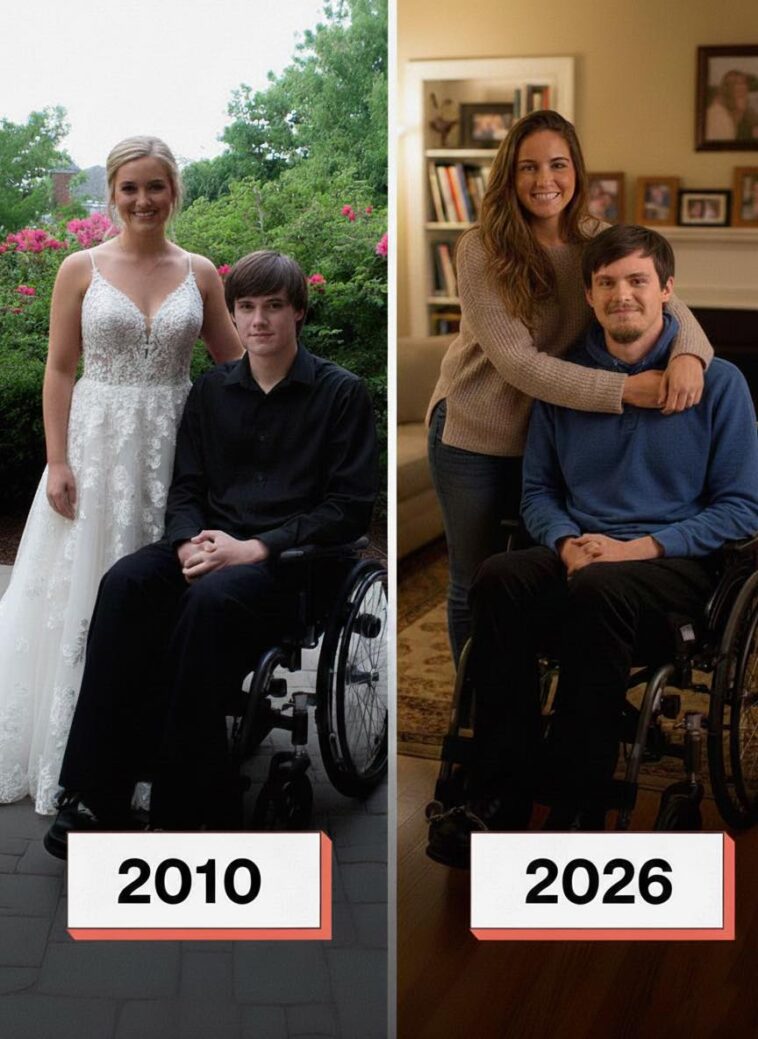
I met my husband in high school.
He was my first love. Not fireworks or dramatic gestures—just a quiet certainty. The kind of love that feels steady, safe, inevitable. Like home.
We were seniors. We were deeply in love. And like most teenagers in love, we believed we were untouchable. We talked about the future as if it were guaranteed—college, careers, a life built side by side. We had no idea how fragile everything really was.
One week before Christmas, that illusion shattered.
He was driving to his grandparents’ house on a snowy night. Or at least, that’s what I believed for fifteen years.
I was sitting on my bedroom floor, wrapping presents, when the phone rang. His mother was screaming. I barely understood the words.
“Accident.”
“Truck.”
“He can’t feel his legs.”
The hospital was harsh lights and antiseptic air. Machines beeped in rhythms that felt cruelly indifferent. He lay in bed with a neck brace, wires everywhere, eyes open but distant.
“I’m here,” I told him, gripping his hand. “I’m not leaving.”
The doctor pulled us aside.
“Spinal cord injury,” he said gently. “Paralysis from the waist down. We don’t expect recovery.”
His mother collapsed into sobs. His father stared at the floor. I felt numb—like my body was present, but my soul had stepped out of the room.
When I got home, my parents were waiting at the kitchen table. They looked calm. Too calm.
“Sit,” my mother said.
I told them what happened. That he couldn’t walk. That I would be at the hospital as much as possible.
“This isn’t what you need,” she interrupted.
I stared at her. “What?”
“You’re seventeen,” she said evenly. “You have a future. Law school. A career. You cannot tie yourself to this.”
“To what?” I snapped. “To my boyfriend who just became paralyzed?”
My father leaned forward. “You’re young. You can find someone healthy. Successful. Don’t ruin your life.”
I laughed because it felt unreal. “I love him,” I said. “I loved him before the accident. I’m not leaving because his legs don’t work.”
“Love doesn’t pay bills,” my mother said. “Love won’t lift him into a wheelchair. You have no idea what you’re signing up for.”
“I know enough,” I said. “I know he would do it for me.”
She folded her hands. “Then this is your choice. If you stay with him, you do it without our support. Financial or otherwise.”
I stared at her. “You’d really cut off your only child for not abandoning her injured boyfriend?”
My father’s jaw tightened. “We won’t fund you throwing your life away.”
The argument went in circles. I cried. I yelled. They stayed cold and controlled.
Finally, my mother said, “Him or us.”
My voice shook, but I said it anyway. “Him.”
The next day, my college fund was gone. The account emptied.
My father handed me my documents. “If you’re an adult,” he said, “be one.”
I stayed two more days in that house. The silence hurt more than the fight.
Then I packed a duffel bag—clothes, books, my toothbrush—and stood in my childhood bedroom, staring at everything I was leaving behind.
And I walked out.
His parents lived in a small house that smelled like laundry and onions. When his mother saw my bag, she didn’t ask a single question.
“Come in, baby,” she said. “You’re family.”
I broke down in her doorway.
We built a life from scraps.
I went to community college instead of my dream school. I worked retail and coffee shops. I learned how to transfer him from bed to chair, how to do catheter care, how to argue with insurance companies. Things no teenager should know—but I did.
I convinced him to go to prom.
“They’ll stare,” he said.
“Let them,” I told him. “You’re coming.”
We danced with me standing between his knees, swaying under cheap lights. I remember thinking: If we can survive this, nothing can break us.
We got married in his parents’ backyard. Folding chairs. Costco cake. A clearance-rack dress.
No one from my family came.
I mailed my parents a birth announcement when our son was born.
No response.
Fifteen years passed.
Life was hard, but I believed we were strong. We’d survived the worst night of our lives—at least, that’s what I thought.
Then one random afternoon, I came home early.
I opened the front door and heard voices in the kitchen.
One was my husband’s.
The other froze me in place.
My mother.
I walked in.
She was standing at the table, red-faced, shaking a stack of papers at him. He sat in his wheelchair, pale, shaking.
“How could you do this to her?” she screamed. “How could you lie to my daughter for fifteen years?”
“Mom?” I said.
She turned to me. Pain flickered across her face—then anger took over.
“Sit down,” she said. “You need to know who he really is.”
My husband looked at me, tears streaming. “Please forgive me,” he whispered.
The papers were emails. Messages. A police report.
The date of the accident.
The route.
An address that wasn’t his grandparents’ house.
Jenna’s name.
Messages between them from that night.
“Drive safe,” she’d written.
“Love you.”
My stomach turned.
“He wasn’t driving to his grandparents,” my mother said. “He was leaving his mistress.”
I looked at my husband. “Tell me she’s lying.”
He didn’t.
“It was stupid,” he said, breaking. “A few months. I thought I loved you both.”
“So you lied,” I said. “You let me destroy my life for you based on a lie.”
“I was scared,” he said. “Then it felt too late.”
“You took away my choice,” I said.
That night, I packed again. This time, for myself and our son.
I wasn’t seventeen anymore.
I walked out—not because I stopped loving him, but because love without truth is nothing.
I’m building something new now. Slowly. Carefully.
I don’t regret loving him.
I regret that he didn’t trust me with the truth.
And that difference changed everything.