AnnaMaria
We were driving down the AP-7 toward Valencia, laughing for no particular reason. It was the kind of laughter that surprises you after grief—the kind that slips out when your body finally believes, even briefly, that life might feel light again.
Sunlight poured through the windshield, warming the dashboard. The road stretched wide and calm ahead of us. In the back seat, my five-year-old daughter Clara hummed softly, turning a small, worn doll over in her hands. I watched her in the rearview mirror and thought—maybe for the first time since my father died—that normal was finally returning.
Then Clara stopped singing.
Not the distracted silence of boredom.
Not the drooping quiet of sleep.
A deliberate pause.
Her voice came next—steady, serious, completely out of place for a child her age.
“Mom,” she said, “Grandpa says we need to stop the car and open the trunk. Right now.”
When Grief Reenters Without Warning
A cold wave moved through my chest so fast it felt physical.
My father, Antonio, had died seven months earlier. A sudden heart attack. Closed casket. Proper funeral. Final in every sense. We had mourned him honestly and painfully. We had said our goodbyes.
I turned my head slowly toward my husband, Daniel. His hands tightened on the steering wheel until his knuckles turned pale. He didn’t look at me. He swallowed hard.
“Clara,” I said, forcing a light laugh that sounded wrong even to my own ears, “don’t say things like that.”
“It’s not a joke,” she replied, meeting my eyes through the mirror. “He’s angry. He says it smells bad.”
That word—smells—landed heavier than the rest.
Daniel eased off the accelerator, just slightly. Too deliberately.
“Who told you that, sweetheart?” he asked, his voice uneven.
“Grandpa,” she said again. “He talked to me yesterday. And today.”
The Moment Logic Begins to Fracture
I wanted to dismiss it. To explain it away as imagination, stress, a child processing loss. Every rational instinct told me to keep driving.
But Clara wasn’t a child who invented stories. She rarely lied, and when she did, it was obvious. More importantly, she hadn’t mentioned her grandfather since the funeral.
And there was something else.
The car.
My father had been a mechanic for decades. To Clara, cars were Grandpa’s domain. His tools. His smell of oil and metal. His stories about engines and trunks and “things that shouldn’t be there.”
“Let’s just keep going,” I said. “We’ll be there soon.”
But Daniel was already signaling, moving toward the exit lane.
“Just for a minute,” he murmured. “So she can calm down.”
Pulling Over When You Don’t Want Answers
The rest area was nearly empty. A few parked trucks. Heat shimmering over asphalt. When the engine shut off, silence flooded the car—thick, suffocating, unnatural.
I stepped out first and opened the rear door, crouching to Clara’s level.
“What do you see?” I asked gently.
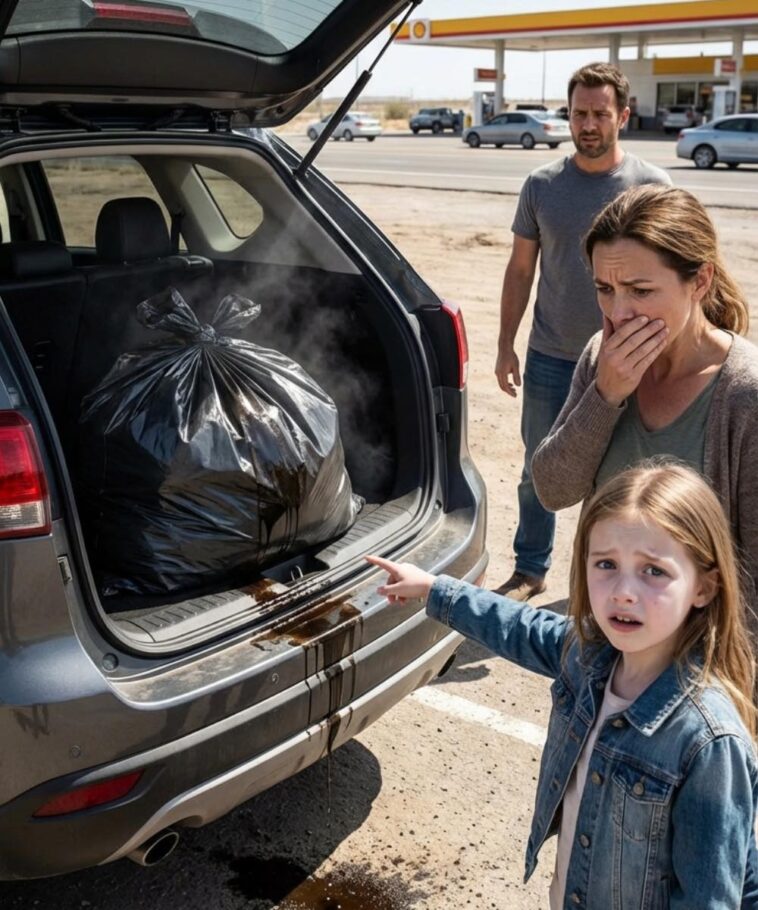
She didn’t hesitate. She pointed behind the car.
“There,” she said. “Grandpa says he shouldn’t be there.”
Daniel walked to the back and opened the trunk.
The smell reached us before anything else—a sharp, sour odor mixed with chemicals. It clawed at the throat. Impossible to ignore.
Inside sat a large black industrial plastic bag, poorly sealed. Dark liquid seeped from one corner.
Daniel staggered backward.
I couldn’t move.
The Instant Everything Makes Sense—and Nothing Does
In that moment, two truths landed with terrifying clarity:
No one had put this there by accident.
And my daughter hadn’t imagined anything.
I didn’t scream. I didn’t cry. My mind detached, as if I were watching the scene from a distance—clinical, cold, efficient.
“What is that, Daniel?” I asked quietly.
He leaned against the car, breathing hard.
“Daniel,” I said again. “What’s in the trunk?”
“Not here,” he whispered. “Please. Not in front of Clara.”
She stood a few steps away, silent, watching us far too closely for a five-year-old.
I called emergency services.
When Authorities Replace Assumptions
Within twenty minutes, the Civil Guard sealed off the area. We were separated. An officer knelt in front of Clara and spoke softly, carefully, like someone trained in child psychology and legal protocol.
She answered in fragments, repeating the same idea.
“Grandpa said he was sick.”
“He said Mom shouldn’t touch him.”
“He said he shouldn’t be in the car.”
When they finally opened the bag, I wasn’t surprised.
Inside were decomposing animal remains—biological waste mixed with chemicals, hastily wrapped. Not a human body, but enough to constitute a serious environmental and legal crime under Spanish law.
The Confession That Followed
Daniel confessed that night.
He worked for a subcontracted waste disposal company—one of those operations buried deep in contracts, liability clauses, and insurance loopholes. Inspections were rare. Oversight was minimal.
A supervisor had asked him to “make certain waste disappear” to avoid fines, offering extra pay in return.
“I was going to dump it somewhere tomorrow,” he said through tears. “I didn’t think—”
“And our daughter?” I asked. “And me?”
He had no answer.
Understanding What My Child Really Heard
The hardest part wasn’t the crime.
It was understanding Clara.
A child psychologist later explained what had happened. Clara had overheard phone calls Daniel made late at night, thinking she was asleep. He used words she associated with her grandfather—bag, trunk, shouldn’t be there, smell, car.
Her mind built a bridge between fear and familiarity. Between danger and protection.
There were no ghosts.
No voices from beyond.
No supernatural warnings.
Just a child using the only framework she had to keep her mother safe.
When Trust Breaks at the Foundation
Daniel was arrested. The company came under investigation. Environmental authorities stepped in. Insurance lawyers followed. Financial penalties mounted.
I went home alone with Clara.
That was when the reality truly hit me—not in the rest area, not with the police, not even with the confession.
But at home, when silence returned.
Daniel hadn’t just committed a crime. He had carried it next to his family. He had exposed his child and his wife to danger—and said nothing.
That night, as I put Clara to bed, she looked at me with worried eyes.
“Is Grandpa angry with me?”
“No, love,” I said, holding her tightly. “He’s proud of you.”
And I meant it.
The Legal Aftermath No One Talks About
The legal process was long, quiet, and devastating in its own way.
Daniel accepted a deal: a fine, a criminal record, immediate dismissal. The company tried to place the blame solely on him. It didn’t work. There were recordings. Messages. Direct instructions. The case briefly appeared in the local press under a dry headline about illegal waste management in the Valencian Community.
I filed for divorce.
Not because of the crime itself—but because for months, he slept beside me knowing he had put us at risk.
And chose silence.
The Damage Children Carry Differently
Clara had nightmares for weeks.
Not about bags.
Not about cars.
She dreamed that no one could hear her.
That was what broke me.
We sold the car. I changed jobs. I changed cities. I left Castellón and moved to a small apartment in Valencia, near the sea. We started over—financially, emotionally, legally.
Health and safety became non-negotiable. Trust was rebuilt slowly. Therapy helped. Stability returned in small, measurable ways.
A Question That Still Matters
Months later, Clara found an old photograph of her grandfather.
“Mom,” she asked quietly, “do you think Grandpa looked after us that day?”
I hugged her tightly.
“I think you took care of both of us.”
And I still believe that.
Today, when I drive, the trunk is always empty—not out of fear, but out of respect. Because there are truths that, when a child can see them before adults, have already gone too far.
And because that day taught me something I will never forget:
Not all warnings come from beyond.
Some come from those still brave enough—and pure enough—to say what no one else dares.
There it is.