AnnaMaria
It Started Like Any Normal Favor
When my sister left town for a short business trip, I agreed to watch her five-year-old daughter without hesitation. It felt routine. Temporary. Safe. I assumed the hardest part would be bedtime negotiations or convincing her to brush her teeth.
The house felt quiet after my sister’s car pulled away. My niece, Lily, stood in the hallway for a moment, staring at the door as if she expected it to reopen. She didn’t cry. She didn’t ask when her mom would be back. She just nodded when I told her we’d have a good few days together.
At first, everything looked normal enough.
The Silence That Didn’t Fit a Five-Year-Old
We spent the afternoon doing the usual things. Coloring books. A blanket fort. Music playing in the kitchen while we danced around like fools. Lily smiled, but it was the careful kind of smile, the kind that looks like it’s checking for approval before it settles in.
As the hours passed, I noticed small things that didn’t quite add up.
She asked permission for everything.
Not big things. Tiny things.
“Can I sit here?”
“Can I touch this?”
“Is it okay if I laugh?”
Each question landed softly but stayed with me. Kids ask questions, sure—but this felt different. It felt rehearsed. Conditioned.
I told myself not to overthink it.
The Dinner That Changed Everything
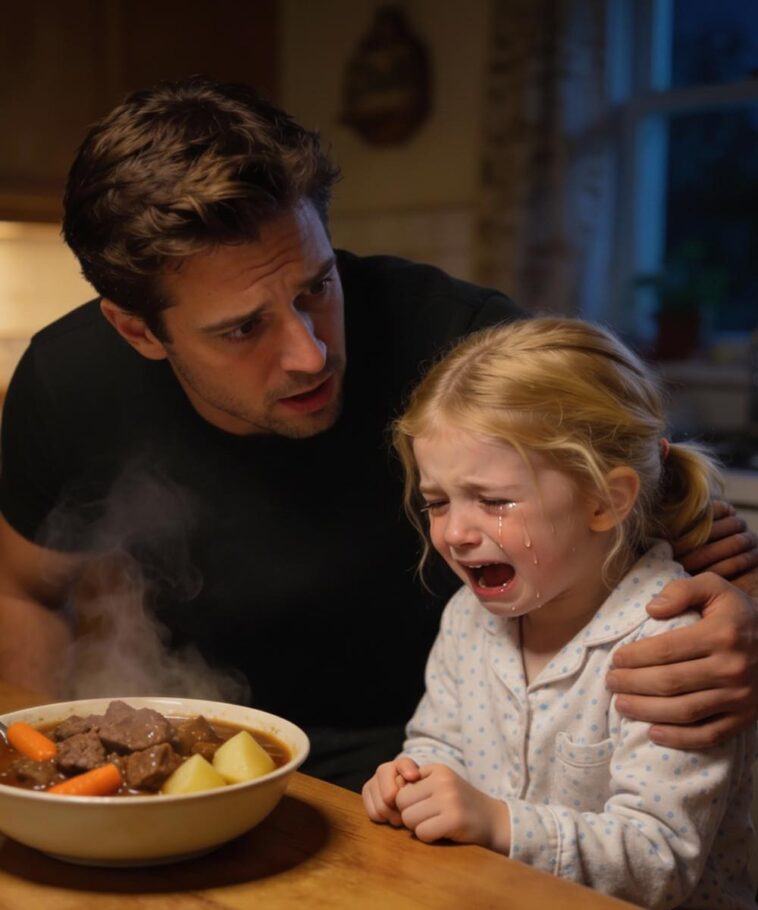
That evening, I made beef stew. The kind that fills the house with warmth before it ever reaches the table. Beef, carrots, potatoes, slow-cooked until everything softened into comfort.
I poured Lily a small bowl, set it in front of her, and sat across from her.
She didn’t move.
She didn’t pick up her spoon. She didn’t even look at me. She just stared at the bowl like it might disappear if she touched it.
After a minute, I asked gently, “Hey, why aren’t you eating?”
She lowered her head.
Her voice was barely audible.
“Can I eat today?”
The question didn’t make sense at first. My brain tried to correct it automatically. I smiled, leaned in, and said, “Of course you can.”
That’s when she broke.
The Cry That Didn’t Sound Like a Child’s
Lily burst into tears so suddenly it startled me. Not a quick sob. Not frustration. These were deep, shaking cries—the kind that come from holding something inside for far too long.
I rushed to her side, kneeling and wrapping my arms around her. She clung to me immediately, like she’d been waiting for permission to fall apart.
I whispered everything I could think of. “You’re okay. You’re safe. You didn’t do anything wrong.”
Each word seemed to make the tears worse.
This wasn’t about stew.
This was about fear.
The Rule She Thought Was Normal
When she finally calmed down, I asked as gently as I could, “Why do you think you’re not allowed to eat?”
She twisted her fingers together, eyes fixed on the floor.
“Sometimes I’m not,” she said.
My chest tightened.
“When?” I asked.
She shrugged, like it was obvious. “When I eat too much. Or when I’m bad. Or when I cry. Mommy says I have to learn.”
I stayed still. No gasping. No anger on my face. Children notice everything.
I said slowly, “Sweetheart, food isn’t a reward. You don’t lose it for being sad or making mistakes.”
She looked up at me like she wasn’t sure I was allowed to say that.
“But if I eat when I’m not allowed,” she whispered, “she gets mad.”
That was the moment I understood something I wish I didn’t have to understand.
Children don’t invent rules like that.
Rewriting the Rules—Quietly
I wiped her face and said, “Okay. While you’re here, my rule is simple. If you’re hungry, you eat. That’s it.”
She stared at me like I’d just changed the laws of gravity.
I lifted a spoonful of stew and held it out. She took it cautiously. Then another. Between bites, she kept looking at my face, waiting for the tone to change.
It never did.
After a few minutes, she whispered, “I was hungry all day.”
I nodded and said nothing, because anything else would have broken me.
The Way Fear Shows Up the Next Day
The next morning, I made pancakes. Fluffy ones. Blueberries mixed in. I set the plate on the table and turned around.
Lily had stopped in the doorway.
“For me?” she asked.
“For you,” I said. “As many as you want.”
She sat slowly, ate carefully, like each bite needed approval. After the second pancake, she whispered, “This is my favorite.”
She didn’t smile. She looked confused.
Throughout the day, the patterns became clearer.
She flinched if I raised my voice—even when calling the dog.
She apologized constantly.
She asked if I would be mad if she didn’t finish things.
Then came the question that almost stopped my heart.
“Do you still love me when I make mistakes?”
I pulled her into a hug and said firmly, “Yes. Always.”
She nodded like she was filing the answer away somewhere important.
When My Sister Came Home
When my sister returned, Lily ran to her—but carefully. Not the full-bodied joy you expect from a child reunited with a parent. More like checking the emotional temperature before stepping forward.
My sister joked that Lily had been “dramatic lately.”
Later, when Lily was out of the room, I told her what Lily had said.
Her face tightened instantly.
“She’s sensitive,” my sister said quickly. “Kids need structure.”
“That isn’t structure,” I replied. “That’s fear.”
She told me I didn’t understand. That I wasn’t her parent.
Maybe I wasn’t.
But I couldn’t forget the way Lily asked permission to eat. Or how she fell asleep with her hand resting on her stomach, like she needed proof the food wouldn’t disappear.
The Question I’m Still Sitting With
That night, I sat alone thinking about something most people miss.
Not all harm leaves marks you can photograph.
Some of it lives in rules children accept without question.
Some of it sounds like whispering, “Can I eat today?”
If you were in my place, what would you do next?