AnnaMaria
Here’s What’s Actually Going On
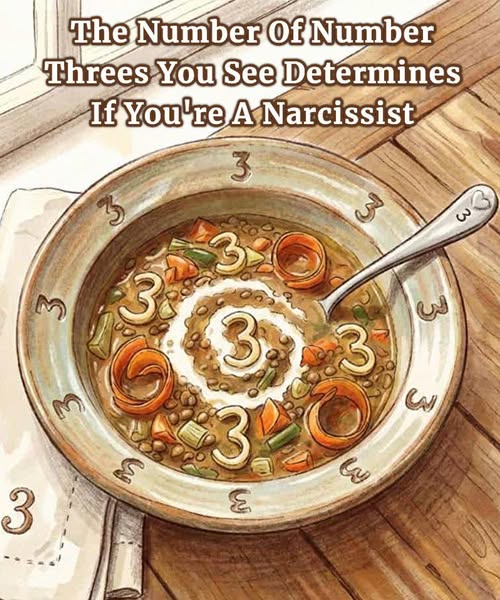
At first glance, it looks like a simple bowl of soup on a table.
But after a few seconds, your brain starts doing something interesting—curves turn into symbols, shadows look intentional, and suddenly you start spotting the number 3 everywhere.
That moment is what makes this image go viral.
But the claim that counting more 3s means you’re a narcissist is not scientifically true.
Let’s explain why.
What This Image Really Is
This picture is an optical illusion based on pattern recognition.
Your brain is designed to:
-
Find familiar shapes
-
Complete incomplete forms
-
Detect meaning even where none was intentionally placed
Once you notice the first “3,” your brain switches into pattern-search mode. From that point on, it actively creates more threes by interpreting curves, highlights, and shadows as numbers.
This is called apophenia—the human tendency to see patterns in random or ambiguous data.
It’s the same reason people see:
-
Faces in clouds
-
Animals in rock formations
-
Words in static noise
None of that has anything to do with narcissism.
Why People See Different Numbers
People notice different amounts because of differences in:
-
Visual attention (detail-focused vs. global focus)
-
Time spent looking
-
Expectations (“I was told there are many, so I’ll keep searching”)
-
Personality curiosity, not pathology
Someone who sees 3 numbers may stop early.
Someone who sees 15 may simply enjoy the challenge.
Neither is better. Neither is unhealthy.
About the “Narcissist” Claim
This part is pure internet exaggeration.
True narcissism:
-
Is a complex personality trait
-
Requires long-term behavioral patterns
-
Is diagnosed through clinical evaluation
-
Cannot be measured by a picture, number, or illusion
Seeing more threes does not mean:
-
You’re self-absorbed
-
You need control
-
You’re obsessed with winning
It usually just means:
-
You’re visually attentive
-
You enjoy solving puzzles
-
Your brain doesn’t quit once it starts searching
Why These Posts Spread So Fast
They go viral because they:
-
Make people question themselves
-
Invite comparison (“How many did YOU see?”)
-
Use dramatic labels to provoke emotion
-
Feel psychological without being scientific
It’s entertainment disguised as insight.
The Real Takeaway
This image doesn’t diagnose anything.
What it does show is something fascinating:
once your brain finds a pattern, it wants to keep going.
That’s not narcissism.
That’s being human.
So if you saw:
-
3 threes → you’re observant
-
10 threes → you’re curious
-
30 threes → you enjoy puzzles
And if you stopped counting halfway through?
Your brain simply decided it had enough information.
Nothing more. Nothing less.