AnnaMaria
The Moment That Stole My Breath
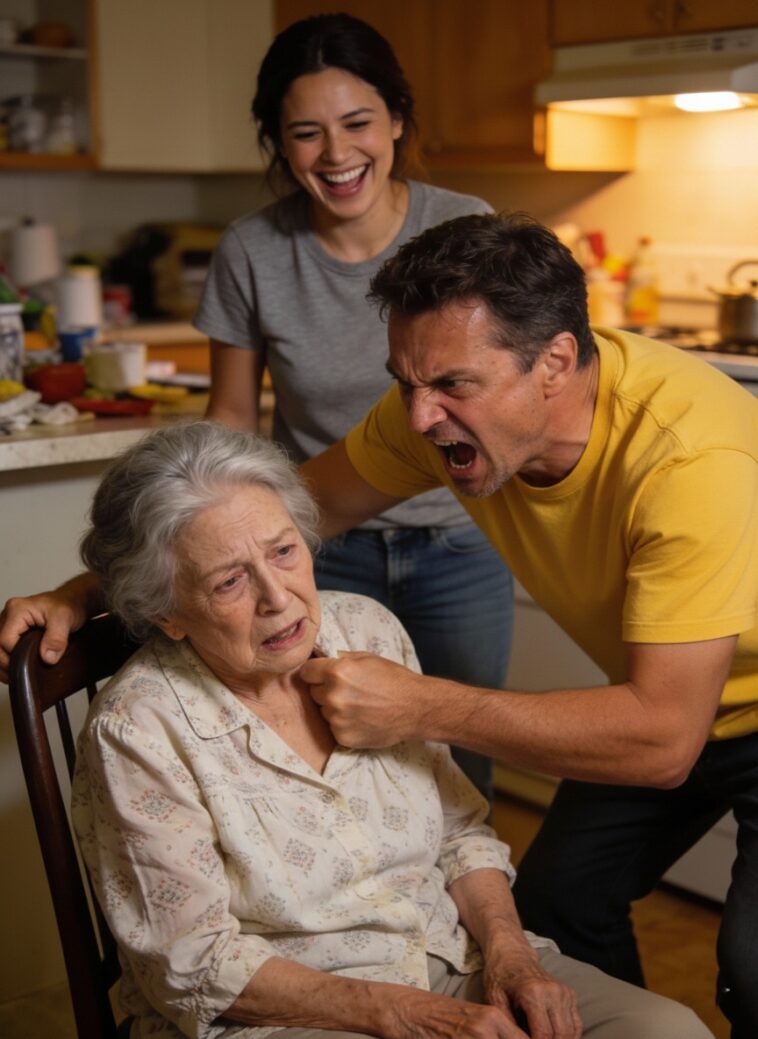
My son grabbed me by the throat and squeezed, his face inches from mine, his voice sharp with contempt. “Obey me, you useless old woman. Go make me dinner—now.”
Air vanished. My vision narrowed. I felt the room tilt as panic pressed in. In the doorway, his wife laughed, as if this were normal, as if my fear were an inconvenience she’d learned to ignore.
I wish I could say I screamed or fought back. I didn’t. I was too stunned to move. What I remember most clearly is not the pain, but the realization forming beneath it: if I survived this moment, I could never live like this again.
When a Voice Stops Sounding Like Your Child’s
His voice didn’t sound like my son’s anymore. It was rehearsed anger, delivered fast and cruel, each word chosen to humiliate. He talked over me, as if my silence were proof of his right to dominate.
“Are you doing this on purpose?” he snapped. “I work all day and you can’t even do what I tell you.”
His grip tightened as if volume alone weren’t enough. In that instant, I understood something painful and undeniable: this wasn’t exhaustion or a fleeting temper. This was a decision.
The Calm That Changed Everything
When he finally loosened his hand—just enough for me to breathe—I didn’t cry. I didn’t shrink away. Something inside me froze, not from fear, but from clarity.
I looked at him not as a mother looks at her child, but as one looks at a stranger who has revealed himself without disguise.
My voice was hoarse, my breath uneven, yet when I spoke it came out steady. “Take your hands off me. Now.”
He laughed, mistaking calm for weakness. His wife laughed too, still standing in the doorway, as if cruelty were a shared joke.
Naming the Line He Crossed
I straightened slowly and said, without raising my voice, “You’ve crossed a line there’s no returning from. What you did wasn’t fatigue or anger. It was a deliberate attack.”
His smile faltered. I told him I hadn’t given birth to be someone’s servant. I told him humiliation was not authority. When he tried to interrupt, I stopped him with a single gesture. He had already said enough.
Leaving With Proof, Not Promises
I turned away, took my coat and bag—packed and ready for weeks—and said calmly that I had already contacted a friend and a lawyer. I told him a doctor would document the marks on my neck. I didn’t threaten. I stated facts.
Facts are louder than fear.
What Survival Looks Like After Silence
Leaving didn’t feel dramatic. It felt necessary. It felt like choosing breath over obedience, dignity over denial. Abuse thrives on invisibility; it weakens when named, documented, and met with action—medical, legal, and human.
If you recognize yourself in this moment, know this: being calm does not mean being weak, and age does not erase your right to safety. Support exists. Documentation matters. Boundaries save lives.