AnnaMaria
A Routine Morning That Wasn’t Routine at All
There was no siren, no urgent radio chatter, no reason for the street to pause that morning in Croix-Rousse. The day unfolded the way it always did in that part of Lyon—quiet sidewalks, bakery doors opening, the low hum of ordinary life continuing uninterrupted.
Until a child spoke.
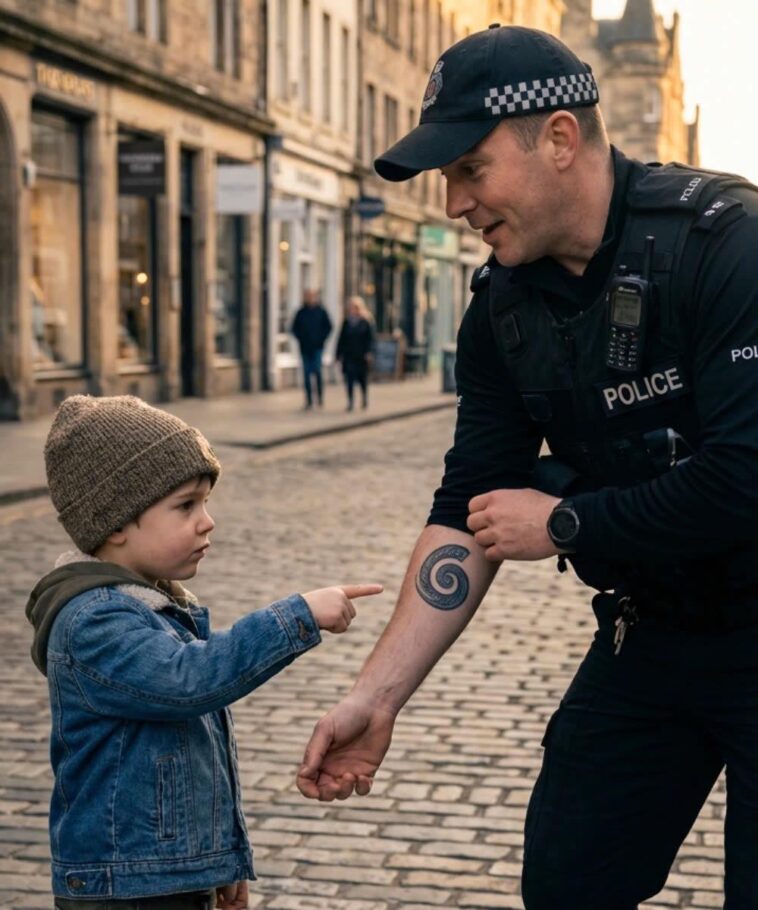
Officer Bastien Moreau had walked this route hundreds of times. Same corners, same buildings, same rhythm. He was mid-step when something brushed against his leg. Instinctively, he looked down, expecting a cat or a drifting leaf.
Instead, he found himself staring into the eyes of a small boy.
The child was no more than four years old. He stood unusually still, his expression focused with a seriousness that didn’t belong to someone so young. He wasn’t looking at the uniform, the badge, or the equipment on Bastien’s belt.
His gaze was locked on Bastien’s right forearm.
“Sir,” the boy said softly, as if speaking might break something fragile, “my dad had the same one.”
The child raised his finger and pointed directly at the Breton triskelion tattoo etched into Bastien’s skin.
In that instant, the world narrowed.
Bastien felt his chest tighten as if a hand had closed around his heart.
That symbol wasn’t common. It wasn’t decorative. It wasn’t chosen lightly. In his entire life, Bastien had known only one other person who carried that exact tattoo.
His twin brother.
The Name He Hadn’t Spoken in Years
Étienne.
The name echoed inside Bastien like a door slamming shut and reopening at the same time. Five years had passed since they last spoke. Five years of silence built from pride, anger, and a single argument so violent it had erased everything that came before it.
They had once been inseparable—two halves of the same life, mirrored in looks and stubbornness. But that closeness had collapsed under resentment and unspoken grief. Bastien didn’t know where Étienne lived anymore. He didn’t even know if he was still in Lyon.
He crouched slowly so he was eye level with the child, forcing his voice to remain steady.
“What’s your name, champ?” he asked gently.
“Leo,” the boy replied without hesitation. “I live over there… with Mrs. Sylvie.”
Leo pointed down the street toward an ochre-colored building Bastien knew well.
The municipal children’s home.
Something cold settled in Bastien’s stomach.
When Details Start to Align
“A children’s home,” Bastien repeated softly. “And your dad—do you remember him?”
Leo nodded, his face brightening for a moment.
“He was tall. Like you,” he said. “Brown hair. Green eyes.”
Bastien’s breath caught.
Leo continued, his voice growing quieter. “But then he changed. He forgot things. Mommy cried a lot.”
Green eyes. Brown hair. Tall.
It was no coincidence. It was genetic certainty.
“And your parents now?” Bastien asked carefully.
Leo looked down at the pavement, scraping his shoe against the stone.
“I don’t know. Mrs. Sylvie says my dad disappeared. Mommy says she’ll come back for me one day.”
The words landed heavier than any accusation. Before Bastien could respond, hurried footsteps approached.
The Woman Who Knew More Than She Said
“Leo!” a woman called out, her voice firm but edged with concern. “How many times have I told you not to wander off?”
She reached them quickly, pulling Leo closer with the reflex of someone used to protecting fragile lives. Her eyes assessed Bastien in a split second—uniform, badge, posture.
Sylvie Dubois.
Director of the home.
“It’s all right,” Bastien said immediately. “We were just talking.”
Leo clutched Bastien’s sleeve. “Mrs. Sylvie, look. He has the same tattoo as my dad.”
The color drained from Sylvie’s face.
Her grip tightened on Leo’s hand. “We’re going inside. Now.”
Bastien stood, heart pounding. “Please—wait. I think I might be able to help.”
Sylvie studied him for a long moment. Exhaustion lined her face, the kind that comes from years of responsibility without enough resources, from making decisions no one thanks you for.
“Do you know someone with that tattoo?” she asked quietly.
“My brother,” Bastien replied. “His name is Étienne Moreau.”
She exhaled slowly, like someone finally setting down a heavy weight.
“Come with me,” she said. “We need to talk.”
The File That Changed Everything
Inside, the children’s home was clean, modest, and orderly. Sylvie led Bastien into a small office and closed the door. Leo ran off toward the playroom without protest.
“Leo arrived here two years ago,” Sylvie began. “We found him alone in Bellecour Square. Crying. He kept repeating one name.”
Bastien already knew the answer.
“Étienne,” she said.
His stomach dropped.
“His mother came days later,” Sylvie continued. “She was exhausted. Pregnant. She said she couldn’t care for him yet. She asked us to keep him safe.”
“And my brother?” Bastien asked.
Sylvie opened a drawer and slid a file across the desk.
“She said Étienne vanished months earlier. After an accident. He became confused, forgetful. Sometimes he didn’t recognize places—or people.”
Bastien pressed his fingers to his temples.
“Why didn’t anyone tell me?”
Sylvie’s voice softened. “Because anger creates distance. And distance hides consequences.”
She removed a photograph from the file.
Étienne stood in it, thinner than Bastien remembered. A young woman held a baby beside him.
“That’s Élise,” Sylvie said. “And that baby is Leo.”
Bastien’s hands trembled.
“I have to find him,” he said.
Memory, Medicine, and Missing Time
Bastien took leave from work. He searched hospital records, registries, insurance files—every system he had access to, every legal channel available.
The truth emerged piece by piece.
Étienne had been hospitalized in Marseille after a motorcycle accident. Two months in a coma. When he woke, his memory was fractured. A nurse remembered him clearly.
“He didn’t recognize anyone,” she said. “A pregnant woman came every day. He never knew who she was.”
Back in Lyon, Bastien returned to the children’s home.
Leo wrapped his arms around his legs.
“Mrs. Sylvie says you know my dad.”
“Yes,” Bastien replied. “Very well.”
“When you find him,” Leo whispered, “tell him I still remember our song.”
And Leo sang.
A lullaby Bastien and Étienne had invented as children, back when the world was smaller and safer.
The Reunion That Healed More Than One Person
Bastien followed the trail south, to Arles. A small blue house. A quiet garden.
“Étienne,” he said.
The man looked up, confusion clouding his face.
“Do I know you?”
Bastien rolled up his sleeve, revealing the tattoo.
“We got these together.”
He paused, then added softly, “And you have a son. His name is Leo.”
Étienne sank into a chair.
“I dream about him,” he whispered.
“They’re not dreams,” Bastien said.
They returned to Lyon together.
When Leo saw Étienne, he smiled without hesitation.
“You’re the man from my dreams.”
“I’m your dad,” Étienne said, his voice breaking.
What the Tattoo Really Meant
A year later, Leo drew a picture of his family. Every figure wore the same tattoo.
“That way,” Leo explained, “we never get lost again.”
Bastien understood then that families aren’t always rebuilt by remembering everything perfectly. Sometimes they are rebuilt by choosing truth, responsibility, and presence—one day at a time.
And sometimes, the smallest voice carries the heaviest truth.