AnnaMaria
The hours that followed unraveled into a haze of sterile hallways, clipped questions, and paperwork passed across counters without anyone meeting our eyes. Time lost its shape. Emery was taken for a full medical evaluation, and we weren’t allowed to follow.
Only Heather was.
I watched her disappear down the corridor beside a nurse, her heels clicking softly against the floor. She held her purse with both hands like it was an anchor. Her back stayed straight. Her face—calm. Too calm. She didn’t turn around. She didn’t ask if we were okay. She didn’t ask how Emery was doing.
She just went.
“I don’t like that,” James murmured beside me.
“Like what?” I asked, though something in my chest already knew.
“Her face,” he said. “She didn’t cry. Didn’t panic. Didn’t even ask about the baby. That’s not shock—that’s distance.”
He was right. Heather didn’t look like a mother terrified of losing her child. She looked like someone already running through explanations, already preparing defenses.
Midnight came and went before the phone finally rang.
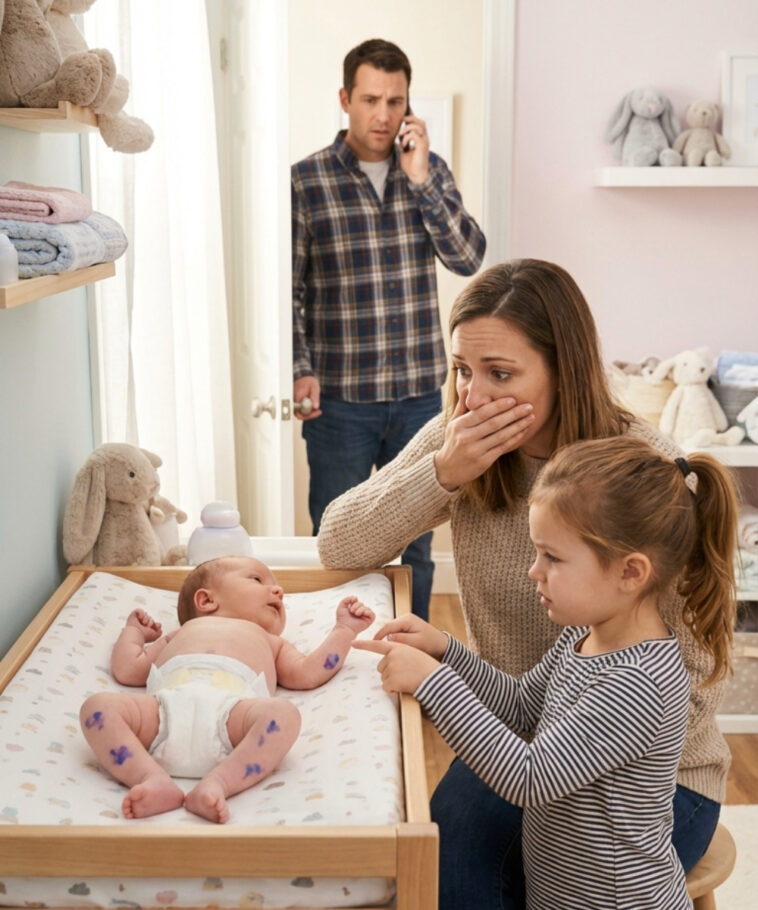
The hospital confirmed Emery was stable, but they were keeping her overnight for observation. The bruises weren’t accidental. The doctor’s voice was careful, precise—trained to soften devastation—but the words still cut straight through me.
Non-accidental trauma.
No medical conditions. No clotting disorders. No explanation that could make this an accident.
The marks were consistent with force. With fingers.
I sat at the kitchen table long after the call ended, staring at the wood grain as if answers might appear there. Behind me, James paced, his footsteps sharp and restless.
“They’re going to ask about her boyfriend,” he said finally.
I looked up. “What boyfriend?”
His pacing stopped. “Heather mentioned him once or twice. A guy named Travis. Or Trevor. I don’t know. She said he didn’t like kids.”
My stomach dropped.
Morning brought no relief—only more questions.
CPS called us in early. Emery would remain in protective custody. Heather was being interviewed again. And yes, they had identified the boyfriend.
Travis Henson. Thirty-three.
Two prior assault charges. One from a bar fight. Another involving his stepbrother.
He’d been living in Heather’s apartment for four months.
We hadn’t known.
She’d never told us.
When detectives tried to locate him, they hit a wall. Travis had vanished. He didn’t show up for work. His apartment was empty. No forwarding address. No witnesses.
Heather said she hadn’t seen him in over a week.
Her phone records told a different story.
She’d texted him just two hours before showing up at our door with Emery.
That’s when the air shifted.
This was no longer about an abusive boyfriend alone. The question turned darker, heavier, impossible to ignore.
Had Heather known?
Had she protected him?
Or had she been part of it?
James sat across from the detective, jaw clenched so tightly I thought it might crack. His voice stayed steady—only because anger had burned everything else away.
“We don’t care about blame,” he said. “We care about Emery being safe.”
“That’s our priority too,” the officer replied. “At this point, Heather is considered a potential accomplice. She’s not under arrest, but her access to the baby has been suspended.”
James’s hand tightened around mine.
I swallowed. “If Emery can’t go back to her… what happens next?”
The CPS worker leaned forward, gentle but direct. “You can petition for emergency custody. You discovered the injuries. You acted immediately. That matters. Right now, you’re the safest option she has.”
I looked at James, and fear gave way to something else.
Resolve.
Because whatever came next—courtrooms, paperwork, sleepless nights—we already knew one thing.
Emery wasn’t going back.
Not on our watch.
That evening, Heather showed up at our door. She looked thinner. Pale. Frayed.
“I didn’t do anything,” she said quickly. “It was him. Travis. I didn’t know it was this bad.”
“You let him live with you,” James said quietly. “Around your newborn.”
“I was tired,” she snapped. “Alone. He said he loved me.”
“You didn’t love Emery enough,” I said before I could stop myself.
Heather flushed, then collapsed into tears.
But none of us trusted those tears.
The weeks that followed were filled with court dates, interviews, and more medical evaluations. Emery stayed in the pediatric ward, gaining weight, feeding well, showing no signs of lasting injury.
CPS documented Heather’s apartment—unwashed bottles, a cracked crib, empty formula cans, stained baby clothes on the floor.
Heather tried to explain it away. Overwhelmed. Postpartum. Isolated.
But under pressure, she admitted something she couldn’t take back.
She suspected Travis had been rough with Emery.
And she didn’t stop him.
That was enough.
She lost custody—temporarily, the court said. But with the weight of her decisions, the likelihood of permanent loss loomed.
We were granted emergency kinship custody. Emery came home with us two weeks later. Lila was ecstatic—carefully gentle, helping with bottles, patting her back during burps like a tiny pro.
We turned the guest room into a nursery. Bought new clothes. Safe formula. We took turns with night feedings. Exhausted, yes—but grateful.
Heather called once. James answered. She asked to visit.
“Not yet,” he said firmly. “Finish the classes. Prove you’re safe.”
She didn’t argue.
A month passed. Then a letter arrived—handwritten, no return address.
I don’t expect forgiveness.
I know I failed Emery.
I let love blind me.
I’m in therapy. I’m taking the classes.
I’m trying to fix what I broke.
If one day she asks about me, please tell her I loved her—even if I didn’t deserve to raise her.
No signature. But I knew.
I folded the letter and kept it. Not for Heather.
For Emery.
One day, if she asks, I’ll tell her the truth—not every detail, but enough.
That she had a mother who made devastating choices.
And an aunt and uncle who chose her—without hesitation.