AnnaMaria
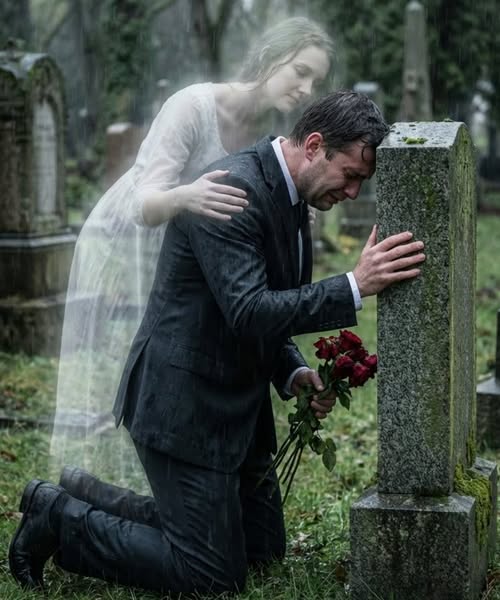
The day before my second wedding, I went somewhere I told myself would be quick. I planned to clear the weeds, straighten the flowers, wipe the stone, and leave. Just a brief visit. A simple act. A quiet goodbye. Nothing dramatic. Nothing emotional. But grief doesn’t follow calendars, and it doesn’t respect schedules. It waits until you think you’re fine, then shows you exactly where the pain is still stored. My name is Daniel Whitmore. Four years ago, my first wife, Anna, died because a drunk driver made one decision on a rainy night. She was thirty-two. One moment she was laughing at something on the radio and the next moment the world changed, and I’ve lived in Seattle ever since, moving through life like a person pretending routine is the same thing as healing. I learned how to function. I learned how to smile at the right times. I learned how to answer “How are you?” without saying the truth. I didn’t learn how to stop missing her. Then Claire entered my life. She didn’t try to rescue me or force me to “move on.” She didn’t demand I become someone else. She simply stayed present where the emptiness was, and she didn’t look away. She noticed the pauses in my sentences. The way I dodged certain memories. The way grief shows up in ordinary conversations like a sudden fog. She asked questions that weren’t invasive, just honest. Slowly, quietly, I fell in love again, and the fact that it was possible terrified me more than I expected. As the wedding got closer, guilt became heavier. Every detail of planning felt like I was betraying Anna. Every moment of happiness felt like theft. I couldn’t tell if I was dishonoring my past by moving forward or dishonoring Claire by loving her with a heart that still ached. That confusion is what pushed me to the cemetery that night, not because I wanted drama, but because I needed somewhere honest.
Why I Went, Even Though I Told Myself I Wouldn’t Stay Long
The rain came down hard enough to soak through my jacket within minutes. I knelt beside Anna’s grave and brushed mud away from the carved letters of her name. My hands shook, not from cold, but from the pressure of everything I had kept tucked away. People tell you time heals. What time often does is teach you how to hide the injury better, how to walk without limping in public, how to keep conversations light. But when you’re alone in a cemetery at night, you don’t have to perform. You can just be what you are. A person who lost someone and never truly understood how to live after that. I stared at the stone, traced her name, and whispered what I had been afraid to say out loud. “I still love you,” I said. “And I love her too. I don’t know how to hold both without breaking.” I expected silence. I expected the rain to be the only response. I expected to feel foolish and leave. Instead, I heard a voice behind me, soft and steady, unmistakably human. “Love doesn’t disappear just because someone does.” I turned, startled. A woman stood a few steps away holding a small bundle of white roses. Rain clung to her hair and coat, yet she seemed oddly composed, not like someone watching a stranger’s pain, but like someone who understood it.
The Stranger Who Said the One Thing I Needed to Hear
She didn’t smile like a person trying to be friendly. She didn’t speak like someone trying to offer advice. Her expression was gentle, calm, the look of someone who had stood in that kind of grief before. “You don’t stop loving the dead,” she continued. “You just learn to carry that love differently.” Her name was Elena Hayes. She said her brother had died overseas three years earlier. Stormy nights pulled her back to the cemetery, she explained, because they felt honest and unfiltered, like the weather matched what she carried inside. We talked, and it didn’t feel like a conversation between strangers. It felt like two people recognizing the same fracture. She didn’t tell me what to do. She didn’t try to fix me. She simply understood what it’s like to live with something you can’t change. When she finally walked away between the headstones, something shifted in me. I wasn’t suddenly healed. But I felt opened. As if the weight I’d been carrying had cracked instead of crushing me. I left soaked and cold, mind spinning with guilt and hope twisting together, inseparable, and I told myself that was the end of it. A strange encounter. A moment of comfort. Something I would remember and move past. But the next day proved grief has a way of carrying moments forward whether you want it to or not.
Standing at the Altar With a Heart Split in Two
The next morning, I stood at the altar and watched Claire walk toward me. Her eyes were steady. Her smile was nervous but real. She looked like someone choosing love even with risk, and it hit me then that love wasn’t a clean replacement. It wasn’t a trade. It wasn’t one person erased so another could fit. Love was more complicated than that, and the guilt I felt wasn’t proof I didn’t love Claire. It was proof I had loved Anna deeply. But Elena’s words echoed like a quiet warning, reminding me that some truths don’t demand answers, only honesty. When the minister asked, “Do you, Daniel, take this woman—forsaking all others?” my throat tightened. My palms went slick with sweat. I could hear the soft shifting of guests behind me. I could feel Claire’s hands in mine, warm and trusting. She deserved certainty. I had none. The minister cleared his throat. “Daniel?” My mouth opened, but the words didn’t come. Everything hung in that suspended moment, the kind where your entire future feels balanced on a single sentence. Then the door at the back of the chapel creaked open. Heads turned. A woman stepped inside, hair pulled back, clothes still damp from the storm, looking almost embarrassed as she slipped quietly into the back pew. Elena. From the cemetery. My stomach dropped. She didn’t wave. She didn’t make a scene. She didn’t look at me like we shared a secret. She just sat down, eyes lowered, as if she had come for her own reasons. But seeing her cracked something open inside me, because it reminded me of what she had said the night before, that you don’t stop loving someone, you learn how to carry it. I inhaled sharply, turned back to Claire, and finally whispered, “I do.” Applause burst through the room. Claire exhaled, gripping my hands like she had been holding her breath too. People smiled, tears were wiped, and everyone around us acted like a hurdle had been cleared. But what I felt wasn’t relief. It was raw vulnerability, as if the vows weren’t a victory, but a surrender to the truth that love can be real and still be complicated.
The Reception Everyone Loved and the Quiet I Couldn’t Escape
That night, at the reception, Claire danced barefoot under string lights, laughing with her friends while glasses clinked and people toasted new beginnings. The room was full of celebration, but I felt split between two worlds, one that had ended and one I was supposed to start. I smiled when someone told a joke. I thanked people who offered congratulations. I watched Claire shine. Yet inside, my mind kept replaying the cemetery, the rain, the headstone, the way my chest had tightened when I said Anna’s name. That disconnection followed us into our honeymoon in Vermont. The lake was calm. The cabin was warm. The air smelled like crisp autumn and pine. It should have been perfect. But silence has a way of amplifying what you’re avoiding, and the quieter things became, the louder my guilt grew. One morning, we drank coffee on the porch, and Claire finally said what I had been refusing to face. “You’re not here with me, Daniel.” Her voice wasn’t accusing. It was tired. “I’m trying,” I muttered, because it was the only honest sentence I had. Claire looked at me with a calm that hurt more than anger would have. “Did you marry me because you love me,” she asked, “or because you’re afraid of being alone?” The question cut straight through every excuse I had built. It wasn’t just emotional. It was also practical in the way adult life can be practical. Marriage is not only about love. It’s also about partnership, finances, planning, insurance decisions, healthcare choices, and legal responsibilities. Claire wasn’t asking to trap me. She was asking if I was truly present in the life we were building, because building a future requires more than a ceremony. It requires commitment you can actually live.
The Counseling Appointment I Didn’t Want and the Truth I Needed
When we returned to Seattle, Claire scheduled grief counseling for us. I resisted at first. I told myself I was fine. I told myself we didn’t need a professional. But she insisted calmly, the way someone insists when they’ve already watched a problem grow large enough to threaten the foundation. In the counselor’s office, Dr. Weiss listened without rushing. She didn’t treat my grief like something to erase. She treated it like something to understand. Then she said one sentence that changed the way I saw everything. “You don’t need to let go of Anna,” she told me. “You need to make room. Love doesn’t replace itself. It expands.” That sentence hit differently than the usual clichés. It didn’t ask me to pick one person and abandon the other. It didn’t frame grief as disloyalty or love as a betrayal. It framed love as something that can grow without erasing what came before. Weeks passed, and the idea began to settle in me slowly, painfully, like a bone resetting. I started noticing how I used guilt as a form of control, like punishing myself would prove loyalty. I started noticing how I avoided joy because joy felt like a legal violation against the past. The irony is that grief often behaves like a contract you didn’t sign but feel obligated to follow, complete with invisible rules and penalties. But no one benefits when you live in permanent emotional debt.
The Letter I Was Afraid to Write
One night, I finally sat down to write the letter I’d been avoiding, the one addressed to Anna. I had postponed it for years because I thought writing it would confirm that she was truly gone. I thought it would reopen everything. In truth, everything was already open inside me. Ink smeared under the weight of tears I couldn’t stop. I wrote about the accident, about how the world felt like it broke and never fully repaired. I wrote about Claire, and the way loving her made me feel both grateful and ashamed. I wrote about the fear of forgetting Anna’s laugh, the fear of replacing her, the fear of moving forward and losing the last connection I had to what we were. When Claire found me at the table, she didn’t interrupt. She didn’t demand to see what I had written. She simply asked, “Do you want me to stay?” I nodded. And as I read the letter aloud, something inside me finally gave way, not in a dramatic way, but in the way a knot loosens after being pulled tight for too long. Claire listened without flinching. She held my hand while I spoke Anna’s name. She didn’t compete with the memory. She didn’t correct my emotions. She allowed the truth to exist without turning it into a threat.
The Choice We Made Together That Changed Our Marriage
After that night, something shifted between us, not instantly, not magically, but slowly, like ice thawing in early spring. For the first time, I stopped fighting my grief like it was an enemy. I began learning how to live beside it. Claire wasn’t threatened by Anna, and I realized I didn’t have to be threatened by the future. Dr. Weiss suggested something I initially refused to consider. “Go to Anna’s grave together,” she said. “Not to replace anything. Just to acknowledge what was.” The idea felt invasive at first, almost disrespectful, as if I were bringing my new wife into sacred space that belonged to my first marriage. But Claire squeezed my hand and said something that surprised me with its maturity. “I want to know every part of the man I married,” she said, “including the love that built him.” That sentence mattered because it wasn’t sentimental. It was stable. It sounded like someone who understands that marriage is built on truth, and truth is not always comfortable. It’s also the basis for long-term partnership, whether you’re talking about emotional health or practical life decisions like family planning, healthcare, and financial security. Avoidance is expensive, emotionally and otherwise, and in adult relationships, that cost shows up in places you don’t expect.
The Visit That Finally Felt Like Peace
So one soft April morning, Claire and I drove to St. Mary’s Cemetery. The sky was clear, the air cool, and the world felt strangely quiet, not heavy like before, just still. I placed lilies on Anna’s headstone, the same kind I had brought the night before my wedding. Then I stepped back, giving Claire space. Claire knelt beside the stone, touched the smooth marble, and whispered words I will never forget. “Thank you,” she said softly. “For teaching him how to love. I promise I’ll take care of him.” Something inside me cracked, but this time it wasn’t pain. It was gratitude. In that moment, Anna stopped feeling like a ghost that haunted my future. She became what she truly was, a chapter of my life, meaningful and permanent, but not a chain. That distinction changed everything. It allowed me to carry love without carrying punishment.
The New Life That Didn’t Erase the Old One
Months later, Claire and I found out we were expecting. When our daughter was born, we named her Grace, because that was what the year had taught us. Grace grew quickly, bright-eyed and curious. When she turned four, she asked why Daddy kept a picture of “the other lady” on the shelf. I knelt beside her and answered in the simplest truth I could give a child. “Her name was Anna,” I said. “She’s in heaven. I loved her very much. And because I loved her, I learned how to love you and Mommy even more.” Claire wrapped her arms around us, and for the first time, I felt like my heart wasn’t divided. It was expanded. We visited Anna’s grave again that year, this time as a family. Not to mourn, but to honor. On the drive home, Claire placed her hand over mine and said, “You didn’t lose your ability to love when she died. You were just waiting to share it again.” I finally believed her. Love doesn’t replace. It expands. It stretches to include what mattered before and what matters now, and it doesn’t ask you to erase your history to deserve your future.
What I Learned About Grief, Love, and Living Forward
If there’s one thing this experience taught me, it’s that grief is not a sign of weakness and it’s not proof you’re stuck. It’s proof you had something real. The goal isn’t to “move on” like flipping a switch. The goal is to make room for life again without pretending the past didn’t happen. For anyone reading this who feels guilty for smiling again, laughing again, or building a future again, understand something important. Your heart is not a one-room house. It’s a structure capable of expansion, capable of carrying more than one kind of love without collapse. Emotional health often looks less like forgetting and more like integrating. And when you integrate, you stop living like you owe the past permanent suffering. You start living like you can honor what was while still building what can be. There it is.