AnnaMaria
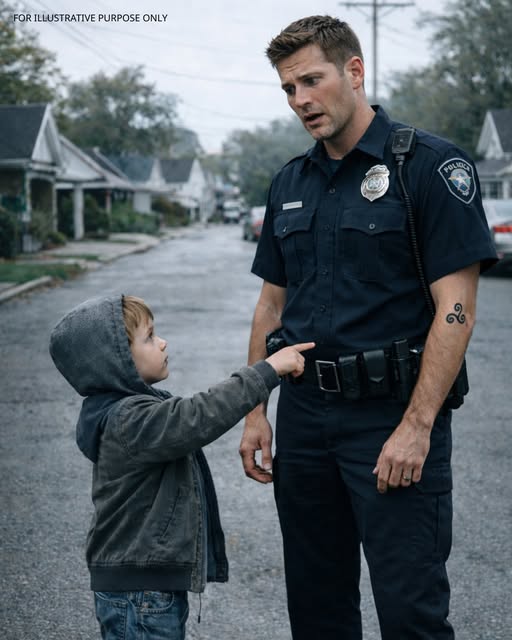
There was no emergency call that morning. No sirens slicing through the air, no raised voices echoing down the street, no flashing lights demanding attention. It was the kind of shift police officers quietly appreciate, a routine patrol through a Portland neighborhood where familiarity bred calm. The air was cool, the sidewalks clean, and the rhythm of the day felt predictable. Officer Lucas Reed had walked this route dozens of times before, nodding to residents, exchanging brief greetings, letting the hours pass without incident. Nothing about the morning suggested it would leave a permanent mark on his life.
Then a small hand gently tapped his leg.
Lucas looked down, expecting a curious glance or a shy smile. Instead, he saw a little boy, no more than four years old, staring up at him with a seriousness that didn’t fit his age. The child wasn’t interested in the badge, the uniform, or the radio clipped to Lucas’s shoulder. His eyes were fixed on Lucas’s right forearm.
“Excuse me, sir,” the boy said carefully. “My dad had the same one.”
He pointed directly at the tattoo etched into Lucas’s skin. A Celtic knot, darkened by time, inked years ago. In that instant, the street seemed to fall silent. Lucas felt his chest tighten, his breath catch. That tattoo wasn’t common. It wasn’t trendy. It wasn’t something you saw on strangers every day. In fact, Lucas had only ever known one other person who wore that exact design. His twin brother.
The Brother He Had Lost to Silence
His brother’s name was Ryan Reed. They had once been inseparable, identical in appearance and instinct, bound by childhood mischief, shared secrets, and an unspoken promise that nothing would ever break them apart. Yet six years had passed without a word between them. Six years of stubborn pride, unresolved arguments, and silence heavy enough to erase addresses, phone numbers, and the sense of where one life ended and the other began. Lucas didn’t know if Ryan still lived in Oregon. He didn’t know if he was alive, married, struggling, or thriving. The silence had grown so complete that even worry had dulled into resignation.
Lucas knelt to bring himself level with the boy, forcing his voice to remain steady.
“What’s your name, buddy?”
“Mason,” the boy said confidently. “I live over there… with Ms. Harper.”
He pointed toward a pale brick building down the street, one Lucas recognized instantly. The county children’s residence. A place he passed regularly but had never entered, a facility tied to social services, family law, and child welfare systems that officers often encountered at the worst moments of people’s lives.
Lucas’s heartbeat quickened. A child under state care. A tattoo only his brother shared. Coincidences happen, but this felt heavier than chance.
“Do you remember your dad, Mason?” Lucas asked gently.
The boy nodded eagerly. “Yeah. He was tall, like you. Brown hair. Green eyes.” Mason paused, his expression shifting. “But then he got strange. He forgot things. Mom cried a lot.”
Lucas felt something twist painfully in his throat. Brown hair. Green eyes. The same build. The same tattoo. Every detail aligned with a truth he hadn’t allowed himself to imagine.
The Woman Who Carried the Truth
“Mason!”
A woman in her early fifties hurried toward them, concern etched deeply into her face. She gently pulled the boy closer, her grip protective but practiced, the kind that came from years of responsibility. “How many times have I told you not to wander off?” she scolded softly. Then she turned to Lucas. “I’m sorry, officer. He’s very curious.”
Lucas noticed the way she held Mason’s hand, firm yet affectionate. This was not a casual caretaker. This was someone who had learned to balance authority with care.
“It’s alright,” Lucas said quietly.
Mason tugged on her sleeve. “Ms. Harper, look. He has the same tattoo as my dad.”
The woman’s eyes dropped to Lucas’s arm. All the color drained from her face. Her grip on Mason tightened immediately.
“We’re leaving. Now,” she said, her voice sharper than before.
Lucas stood, instinctively. “Please,” he said. “May I ask you something about his father? I think I might be able to help.”
She studied him carefully, her gaze guarded, tired, shaped by years of working within systems that often failed the most vulnerable. “Do you know someone with that tattoo?”
“My brother,” Lucas replied. “He has the same one.”
She hesitated, then asked quietly, “What’s his name?”
“Ryan Reed.”
She exhaled slowly, as if releasing a breath she’d been holding for years. “Come inside,” she said. “We need to talk.”
The File That Changed Everything
The office inside the residence was simple and clean, decorated with children’s drawings and carefully chosen furniture designed to feel safe rather than institutional. Ms. Harper closed the door while Mason joined other children in the playroom.
“Mason has been with us for two years,” she began. “He was found alone near the downtown transit station. He kept repeating one name.”
Lucas already knew. His stomach tightened before she said it.
“Ryan,” she said softly.
The confirmation hit harder than he expected. “His mother?” Lucas asked.
“She came days later,” Ms. Harper explained. “Exhausted. Pregnant again at the time. She said she needed time. She still calls once a month from different phones. Always asks if Mason is eating, growing. Never says where she is.”
Lucas ran a hand through his hair. “And my brother?”
Ms. Harper opened a drawer and slid a folder across the desk. “According to her, Ryan changed after an accident. Confused. Forgetful. Sometimes didn’t recognize people.”
The weight of regret pressed heavily on Lucas’s chest. “Why didn’t anyone tell me?”
She met his eyes. “Because you and your brother stopped speaking. And pride, Officer Reed, often does more harm than people realize.”
She pulled out a worn photograph. Ryan stood in it, thinner and older. Beside him was a young woman, her arm wrapped protectively around a baby. “That’s Elena,” Ms. Harper said. “And that’s Mason.”
Lucas’s hands trembled. “He’s my nephew.”
Searching for a Ghost
Lucas took leave from work. The badge and uniform that had once defined his identity suddenly felt secondary to the responsibility he had ignored for years. He searched hospital records, accident reports, and social service databases, navigating systems that intertwined healthcare, insurance documentation, and legal records. It took time, persistence, and more than one reminder of how fragmented support systems can be when families fall apart.
Eventually, the truth surfaced. Ryan had been hospitalized in San Diego three years earlier after a motorcycle accident. A nurse remembered him clearly. “He was unconscious for weeks,” she said. “When he woke up, he didn’t recognize anyone. A woman came every day. Pregnant. Crying.”
Elena.
Lucas drove back north, his thoughts racing. When he returned to the residence, Mason ran into his arms without hesitation. “Ms. Harper says you knew my dad.”
“Yes,” Lucas said softly. “We were very close.”
“Then why doesn’t he come?”
Lucas knelt. “I’m looking for him.”
Mason smiled with a confidence that felt almost reassuring. “Good things take time,” he said. “But they come.”
Before Lucas left, Mason tugged his sleeve again. “When you find him, tell him I still remember our song.”
He sang it. A lullaby Lucas and Ryan had made up as children, a silly tune that somehow survived years of silence and trauma. Even broken memory hadn’t erased that.
The Brother Who Didn’t Remember
The trail led to Santa Barbara. A small blue house with a modest garden out front, the kind of place chosen for quiet rather than ambition. Lucas knocked. A man opened the door.
“Ryan,” Lucas whispered.
The man frowned, studying his face. “Do I know you?”
“I’m Lucas. Your brother.”
Ryan’s eyes drifted to the tattoo on Lucas’s arm. “That’s mine too,” he murmured. “I don’t remember when.”
“You have a son,” Lucas said carefully. “His name is Mason.”
Ryan’s face crumpled. “I dream about him,” he admitted. “I thought they weren’t real.”
“They are,” Lucas said. “They’re real.”
Ryan sat down heavily. “I left because I was afraid,” he confessed. “Waking up with no memories… it felt like drowning. I didn’t want to hurt anyone.”
Lucas placed a hand on his shoulder. “You don’t have to do it alone anymore.”
A Family Rechosen
They returned together. Elena came the following week, cautious but hopeful. When Mason saw Ryan, he smiled without hesitation. “You’re the man from my dreams.”
“And you’re the boy from mine,” Ryan replied, his voice breaking.
“Are you my dad?” Mason asked.
“Yes,” Ryan said softly. “I am.”
“Why did it take so long?”
“Because I was lost,” Ryan said. “But I found my way back.”
Mason hugged Lucas tightly. “Uncle Lucas is a hero,” he declared.
A year later, Mason drew their family. All of them bore the same tattoo in his drawing. “Why?” Lucas asked.
“So we don’t get lost again,” Mason replied.
Lucas understood then that family isn’t rebuilt by remembering the past alone. It’s rebuilt through responsibility, accountability, and daily choices. In a world shaped by legal systems, healthcare barriers, and financial uncertainty, what ultimately heals is presence. Not authority. Not pride. Presence.
Sometimes, the smallest moments reveal the biggest truths. A child’s observation. A familiar tattoo. A quiet morning that turns into a reckoning. And from that point forward, everything moves differently.