AnnaMaria
Sunday evenings always carried a strange, heavy silence for Michael Reeves. At exactly 7:00 p.m., every single week, he pulled his aging sedan to the curb outside his ex-wife’s townhouse in Aurora, Colorado. The routine never changed. The neighborhood was always calm in that unsettling way suburban streets can be. Porch lights flickered on one by one. Somewhere down the block, a family laughed around a dinner table. A dog barked and then went quiet. Michael checked the clock on the dashboard, inhaled slowly, and repeated the same thought he had trained himself to believe.
“Just picking up Lucas. Twenty minutes home. That’s it.”
He told himself this because routine felt safe. Predictability felt manageable. After the divorce, routines were the only thing holding his life together. Shared custody had been labeled “fair” by the court, wrapped in neat legal language about stability and cooperation. Michael wanted to believe in that fairness. He needed to believe it.
The front door opened.
Lucas stepped out slowly, backpack hanging off one shoulder. He was nine years old, tall for his age, usually bursting with restless energy. Normally, he ran to the car. Normally, he talked nonstop about school, video games, or whatever had captured his attention that week.
Tonight, he didn’t run.
He walked carefully. Deliberately. Like each step required permission from his body.
Michael’s chest tightened.
He opened the driver’s door and stepped onto the sidewalk.
“Hey, buddy,” he said gently. “You okay? Why are you walking like that?”
Lucas looked up and forced a small smile that never reached his eyes.
“I’m fine, Dad. Just tired.”
Tired.
The word landed with a familiar weight. Michael had heard it before. Too many times. Children don’t always know how to name pain, but they know how to hide it.
Michael opened the back door and gestured toward the seat.
“Hop in, champ.”
Lucas froze.
His fingers trembled slightly on the door handle. His eyes widened just a fraction, as if the seat itself were dangerous.
“Go ahead,” Michael said softly. “You’re okay.”
“Yeah… okay.”
Lucas tried to sit. For a split second, his face cracked. Sharp pain flashed across it before he buried it behind a practiced stillness. He perched on the very edge of the seat, stiff and upright, careful not to lean back.
Michael closed the door slowly.
During the drive along Interstate 225, Lucas never once rested against the seat. He leaned forward the entire way, gripping his backpack strap, body rigid like a coiled wire.
Michael tightened his grip on the steering wheel.
“So… what’d you do this weekend?” he asked, forcing his voice to sound normal.
“Nothing,” Lucas said quickly. “Stayed home.”
“Played anything?”
Lucas swallowed.
“Yeah. I ran around a lot.”
Michael glanced in the rearview mirror.
Children don’t lie like adults do. Their lies aren’t polished. They aren’t clever. They are shaped by fear. And fear has a sound. Michael heard it clearly.
A Home That Should Have Felt Safe
Michael’s house in Parker, a clean two-story home he had bought years before the divorce, was supposed to be a refuge. It had wide windows, neutral walls, and a backyard Lucas used to love. But when Lucas stepped out of the car, his movements were even slower than before. His legs were slightly apart, his posture tense, as if sitting hurt more than walking.
Michael’s mouth went dry.
“Lucas,” he said quietly. “Tell me the truth. Are you hurting somewhere?”
“No, Dad. Really.”
The answer came too fast.
Inside, Michael heated leftovers and set the table. Lucas hovered instead of sitting.
“Sit down, son,” Michael said gently.
Lucas obeyed, but only barely. He lowered himself onto the edge of the chair, shoulders rigid, jaw tight. After five minutes, he stood again.
“I need the bathroom.”
Michael watched him walk down the hallway, every step careful, measured. A realization crept in, cold and unwelcome. It was something Michael didn’t want to understand, but already did.
He knocked softly on the bathroom door.
“Lucas, I need to talk to you.”
“One minute, Dad.”
When Lucas came out, Michael knelt to meet him at eye level. He took his son’s hands. They were cold.
“You’re not in trouble,” Michael said. “But you’re in pain. I can see it.”
Lucas’s eyes filled instantly, like a faucet had been turned on inside him.
“Dad… I can’t tell you.”
Michael’s heart pounded.
“Why not?”
Lucas pressed his lips together, trying to stop himself from crying.
“Mom said if I tell you… it’ll be worse next time.”
The house went silent.
The hum of the refrigerator. The ticking clock. The air itself felt heavy.
Michael swallowed hard.
“Look at me,” he whispered. “Whatever happened, we’ll fix it. But I need to know.”
Lucas collapsed into sobs.
“She hit me,” he cried. “With a belt. A lot. It hurts so bad.”
Michael felt rage and fear surge through his body at once.
“Where did she hit you?”
Lucas pointed behind himself, ashamed, then down to his legs.
“She said I deserved it.”
“For what?”
Lucas sniffed.
“I spilled juice. It was an accident.”
Michael closed his eyes.
A spill. A child. A belt.
Nausea rose in his throat.
When a Parent Knows There Is No Waiting
“I need to check you,” Michael said softly. “Just to see if you need a doctor.”
Lucas shook his head.
“I’m embarrassed.”
“I know,” Michael said. “But I’m your dad. And your body is asking for help.”
In Lucas’s room, Michael turned on a dim lamp. Carefully, gently, he looked.
The sight stole his breath.
Dark bruises. Long, linear marks that could not be accidents. Some fresh. Some fading. Injuries layered in time, in places no child should ever be hurt.
Michael’s vision blurred.
“Oh God…”
“Mom said it wasn’t that bad,” Lucas whispered. “She said she had it worse growing up.”
“That doesn’t make it okay,” Michael said, his voice steady only through sheer force. “It makes it wrong.”
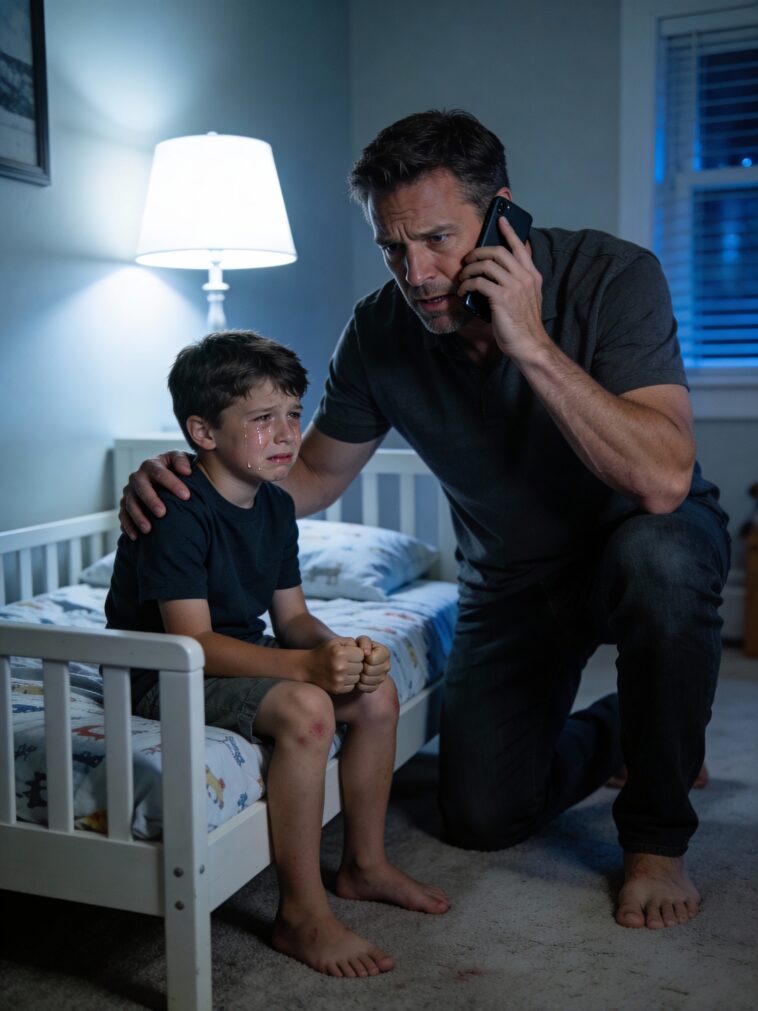
He documented what he needed to quickly and gently, thinking with terrifying clarity. Then he picked up his phone and dialed 911.
“I need an ambulance,” he said. “My son has injuries from physical abuse.”
Under Hospital Lights That Don’t Lie
Sirens cut through the night.
At UCHealth Anschutz Medical Campus, Lucas lay on a bed under bright lights. Dr. Samuel Porter examined him with careful professionalism.
“Mr. Reeves,” the doctor said gravely, “your son has significant bruising. Some areas need treatment to prevent infection.”
He paused.
“These injuries didn’t happen all at once. There are marks from different days.”
Michael felt something inside him fracture.
“Different days?”
The doctor nodded. He pointed out grip-shaped bruises on Lucas’s arms. A small burn on his hand.
“Lucas,” the doctor asked gently, “how did this happen?”
Lucas looked at his father.
Michael nodded.
“Tell the truth, buddy. You’re safe.”
“She burned me with her cigarette,” Lucas whispered. “She said it was an accident.”
The doctor’s jaw tightened.
It wasn’t an accident.
The doctor stepped out and made a call.
When the System Finally Steps In
A social worker from Colorado Child Protective Services, Angela Morris, arrived within the hour. She spoke to Lucas privately while Michael paced the hallway, his thoughts racing through guilt, fear, and fury.
When Angela emerged, her expression was firm.
“Your son reports a pattern of physical harm during visits with his mother,” she said. “This has been happening for about six months, since court-ordered visitation began.”
Michael leaned against the wall.
“Six months…”
“She threatened him,” Angela added. “Told him you wouldn’t believe him. Children stay silent when silence feels safer.”
Michael nodded slowly.
He understood that now.
Evidence That Could Not Be Explained Away
Law enforcement visited the mother’s apartment that night.
They found a thick leather belt. Marks inside a small closet. And then something worse.
A notebook.
Dates. Notes. Cold sentences written without emotion.
Didn’t finish dinner
Spilled juice
Talked back
This wasn’t losing control.
This was routine.
When Justice Moves Slowly but Decisively
The trial was quiet and heavy.
Lucas testified by video.
When asked why he stayed silent, he answered simply.
“Because every Friday, when Dad dropped me off… I already knew what was coming.”
The judge ruled decisively.
Prison time. Permanent loss of custody. A strict restraining order.
But healing did not start with the verdict.
What Healing Really Looks Like
Healing began with therapy.
Lucas feared belts. Closed doors. Darkness.
Michael removed every belt from the house.
One night, Lucas asked, “Dad… was it my fault? I spilled the juice.”
Michael held him tightly.
“Spilling juice is being human,” he said. “Nothing ever justifies hurting you.”
Months passed. Slowly, Lucas slept through the night. Slowly, laughter returned.
One Year Later
At ten years old, Lucas came home from school holding a poster board covered in glitter.
“We had to do a project on bravery,” he said.
“Who’d you choose?” Michael asked.
Lucas smiled.
“Me. Because I told the truth.”
Then softly, “And you. Because you noticed.”
Michael cried openly.
“You’re the brave one,” he said. “I just listened.”
Lucas nodded.
“Now I know I can tell you anything.”
“Always,” Michael replied. “Always.”
The Quiet That Finally Meant Safety
That night, the house was quiet.
Not the kind of quiet that hides fear.
But the kind that signals safety.
The kind every child deserves.