AnnaMaria
The familiar sting of family holidays had become as reliable as the autumn centerpiece on my mother’s dining table. Pretty on the surface, draining underneath, and somehow always ending in the same quiet ache. Every Thanksgiving at the Hawthorne house ran on a script my older sister Madison had perfected over the years, with aunts, uncles, and cousins happily playing their roles as her cheering audience. And I was always cast as the joke. It wasn’t subtle. It wasn’t accidental. It was tradition, delivered with smiles and laughter so practiced that no one had to think about whether it was kind.
The moment I walked in, still wearing my navy transit uniform, Madison’s voice rang out like she’d been waiting for her cue. “Well, look who finally made it,” she called, loud enough for the whole room to hear. “How many buses did it take this time, three? Or did someone finally feel sorry enough to give you a ride?” The words hung in the air like heavy perfume, sweet to everyone else and suffocating to me. Laughter arrived right on schedule from the long table, silverware flashing under the chandelier as if the room itself approved.
I offered a small smile, set my purse down, and took the chair that somehow always ended up at the far corner of the smaller table. I was thirty-two, but in that house, I’d never been promoted. “Just one bus,” I said lightly. “Traffic wasn’t awful.” Madison’s crowd leaned in the way audiences do when they know the show is going to get better. My cousin Ethan repeated my words with a grin, as if he’d been handed a gift. “One bus. At thirty-two. That’s dedication. Proud of you, Emily.” More chuckles, soft and familiar. My uncle Thomas, a retired attorney who treated Madison’s cruelty like theater, lifted his wineglass toward me and made a toast. “To the heroes of public transportation,” he announced. “Keeping the bus system alive one ride at a time.”
Madison glowed. The spotlight slid neatly back to where she liked it. She sat near the head of the table in a white-and-gold designer dress I recognized instantly, because she’d posted it on Instagram two weeks earlier with a caption about timeless confidence. Her engagement ring caught the light every time she moved, as if she’d trained it to sparkle on command.
Then she tilted her head, her smile sharpening. “You know what I was telling Mom earlier,” she said, loud enough for the whole room to hear. “You’re probably never going to own a car. And honestly, at this point, why even try? You’d just fall behind on payments anyway.” She said it like advice. Like concern. Like she was doing everyone a favor by saying what they all supposedly thought.
“Probably,” I said evenly, spooning cranberry sauce onto my plate. “Cars aren’t cheap.” Madison laughed as if I’d delivered a punchline. “Not cheap? A used Honda Civic is not cheap to you? Do you have any idea what I paid for my BMW?” With a dramatic sweep of her hand, she pointed toward the window. In the driveway, visible to everyone, sat a shiny black BMW sedan, spotless even in the fading afternoon.
“Sixty thousand dollars,” she said, savoring each syllable. “Cash.” Admiring murmurs floated around the table. My aunt Carol even clapped softly, like she was congratulating someone after a piano recital. Madison soaked it up like sunlight.
I kept cutting my turkey.
“People just focus on different things,” I said, keeping my voice calm. Ethan echoed it with a smirk. “Different things. That’s one way to describe taking the city bus to Thanksgiving dinner.” Another cousin leaned in, thrilled to participate. What did I do when it rained, did I get drenched, did I call Mom for a ride like I was sixteen again. I said I figured it out. That should have been the end of it, but Madison’s fiancé Ryan leaned forward, the kind of man whose smile never quite reached his eyes. “I saw Emily at the bus stop last month,” he said casually. “Standing out there in the rain with this tiny umbrella. It looked so…” He paused, letting the moment stretch. “Pathetic.”
My mother shifted uncomfortably. My father studied the gravy boat like it had become fascinating. Madison pretended to soften the blow, but her tone suggested she liked the word. “Pathetic is a little harsh,” she said. “I prefer realistic. Some people understand their limits. And there’s nothing wrong with that.” Uncle Thomas nodded approvingly. “Very practical.”
I let the laughter roll over me like static. They assumed I was shrinking, swallowing humiliation the way I always did. But I wasn’t shrinking. I was watching. Madison had a pattern to her cruelty, an emotional choreography she repeated every year. A few light jabs to warm up the room, then sharper cuts, then a final blow, usually saved for dessert. This year, she seemed unusually energized. She kept checking her phone and glancing at the time, her expression bright with anticipation, like she’d arranged something special for the grand finale.
The Part They Never Noticed Was My Silence
After years of being the family’s convenient target, I’d learned something most people never bother to learn. Silence isn’t always surrender. Sometimes it’s strategy. Sometimes it’s restraint. Sometimes it’s the choice to let someone reveal their character without interruption. That night, I wasn’t surviving the jokes. I was taking inventory.
Madison topped off her wine and announced, “You know what’s really sad? Emily actually believes she’s going to make it somehow.” My aunt Carol muttered something under her breath, settling in like the show had officially begun. Madison’s smile turned syrupy. She started mocking my “little business ideas” and my “investments,” drawing out the word as if it were childish. Ethan snorted. What kind of investing could I possibly do on a dispatcher’s paycheck. I corrected him calmly. I wasn’t a driver. I dispatched. Madison rolled her eyes. “Sitting in a booth telling drivers where to go. Very corporate.”
The laughter sharpened. Madison leaned back, pleased. She told everyone what I had said the year before, that I was building something big. Ryan played along with fake astonishment. Maybe I was building a better bus route. Another cousin joked about a taxi company. Madison grinned, triumphant. I would need to afford a car first.
I glanced at my watch.
6:47 p.m.
Close.
Their voices blurred into background noise. Madison wasn’t finished. She was just warming up. She adopted a wounded, charitable tone, as if she were delivering a necessary truth for my own good. I was thirty-two. I took the bus everywhere. I lived in a tiny apartment. I worked for the city. That was my life and I should accept it. Uncle Thomas chimed in, talking about dignity and knowing one’s place. Madison nodded like a generous queen. I should stop pretending I’d suddenly become a business mogul, she said, because it was embarrassing for everyone.
6:52 p.m.
Right on time.
The Moment I Stopped Playing Along
“You’re right,” I said, setting my fork down. The table didn’t quiet immediately, because they assumed it was just another line in the performance. Then Madison blinked. “Excuse me?”
“I said you’re right,” I repeated calmly. “I should probably be more realistic about transportation.” Madison’s smile spread slowly, pleased, smug. She thought I was finally cracking. She thought she had won. “Finally,” she said, opening her arms slightly. “A little self-awareness. That’s all I ever wanted.”
I slipped my phone from my pocket. It buzzed once, then twice, exactly the signal I had arranged. I stood.
“You know,” I said, “you’re not wrong. The bus thing might be a little awkward.” Madison tilted her head, amused. “Just don’t go buying something you can’t afford, Emily.” I smiled faintly. “Oh, I’m not buying anything tonight.”
Then I tapped one button and put the call on speaker.
“Parker Aviation, Captain Miller speaking,” a crisp male voice answered.
The room snapped into silence like someone had flipped a switch.
“Hi, Captain,” I said. “Are we set for pickup?”
“Yes, Miss Parker,” he replied. “We have three helicopters in the area. Landing zone confirmed on the residential street you specified. Four minutes out.”
“Perfect,” I said. “See you shortly.”
I ended the call and slid my phone back into my pocket.
Eight faces stared at me like their brains had stalled.
My mother’s eyes widened. “What was that?”
“My ride,” I said simply.
Madison let out a thin laugh. “You’re joking.”
“About helicopters?” I asked. “Never.”
The Sound That Erased Every Word She’d Spoken
The sound arrived first, low and distant, then growing louder with every second.
Whup whup whup.
Rotor blades.
Ryan spoke first, voice tight. “Did she just say helicopters, plural?”
“Three tonight,” I said casually, walking to the window. “I like backups. Mechanical issues happen.”
The table collapsed into confusion. My uncle’s wineglass trembled in his hand. “Emily,” he managed, “what do you do?”
“I own Parker Aviation,” I said. “Medical transport, executive flights, tourism. Around fifty aircraft.”
My aunt blinked hard. “Fifty?”
“Fifty-three,” I corrected. “We added three new medical units last week.”
Madison’s jaw fell open. “That’s not real.”
“It is,” I said quietly. “The city contracts my company for emergency response. The dispatch job is how I oversee those contracts from the inside.”
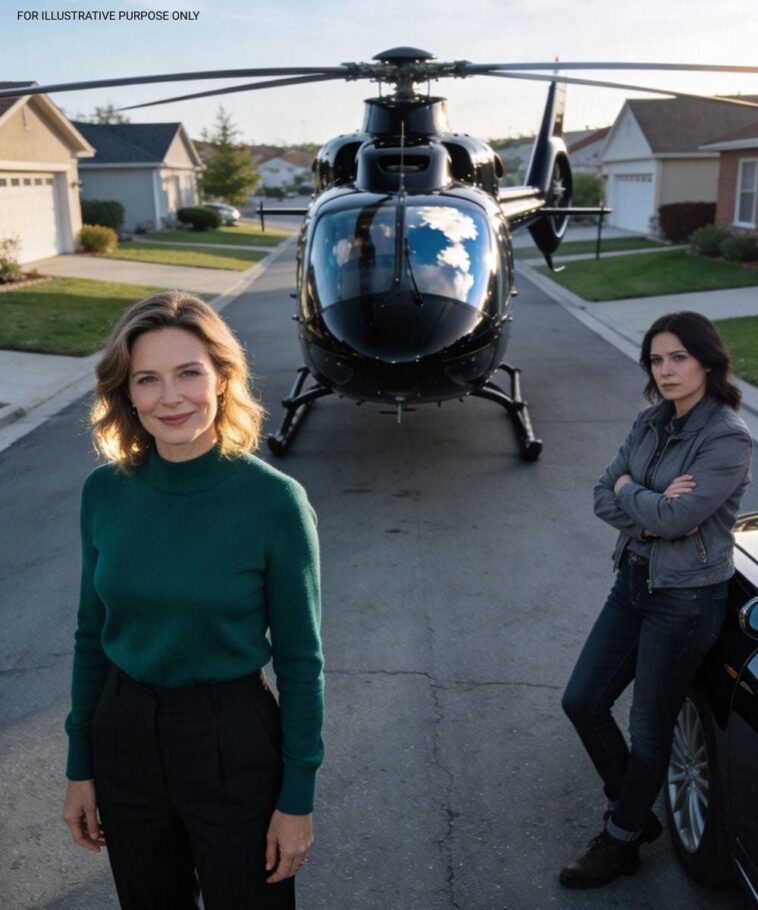
Outside, sleek black helicopters crested over the neighborhood, dark silhouettes edged with light. Each one had gold lettering on the side.
PARKER AVIATION.
Madison stared as if her mind refused to cooperate.
One helicopter descended directly in front of her BMW. The gust rocked the car. Leaves and dust spiraled into the air. My mother gasped, clutching her napkin like it could anchor her. A second helicopter came down. Then a third. All identical. All mine.
Madison stood abruptly, face draining. “You take the bus. You can’t afford this.”
“I take the bus because it’s environmentally responsible,” I replied. “And because it gives me time to handle calls. Helicopter fuel isn’t cheap.”
Ryan frantically searched on his phone, typing like his ego depended on it. His eyes widened. “Parker Aviation founded 2015 annual revenue forty-seven million?”
“Last year,” I said. “This year we’re tracking closer to sixty-five.”
My uncle’s wineglass slipped from his hand and shattered on the floor. The sound was sharp, like punctuation.
“Sixty-five million,” Madison repeated, hollow, as if saying it out loud might make it less true.
“Give or take,” I said.
My phone buzzed again. Captain Miller: Ready for departure, Miss Parker.
“Well,” I said, grabbing my jacket, “that’s my cue.”
The Sentence That Finally Landed
At the table, I paused and looked directly at Madison.
“Thank you,” I said gently, “for reminding me to stop pretending to be something I’m not.”
Her lips trembled. “What does that mean?”
“It means I’m done pretending I’m broke,” I said calmly.
I opened the front door as Captain Miller approached in full uniform, headset catching the porch light.
“Ms. Parker,” he said with a crisp salute. “Your aircraft is ready. Home, or the main office?”
“Home,” I said. “It’s been a long dinner.”
He nodded.
I looked back once. Every face was stiff with disbelief. Not anger. Not laughter. Just the sudden discomfort of people realizing they had built their confidence on a story that wasn’t true.
“Happy Thanksgiving,” I said. “Next year, maybe I’ll drive. Or fly.”
Then I stepped into the roaring wind, cold air and fuel scent filling my lungs. I climbed into the center helicopter, settled into a leather seat, and felt the lift as we rose. Below, the street glowed with porch lights, and Madison’s BMW wore a thin coat of dust from rotor wash.
“You okay, Miss Parker?” Captain Miller asked through my headset.
“Perfect,” I replied. “Take me home.”
The city spread beneath us, lights and motion and noise. And somewhere far below, buses crawled through traffic, carrying people who never knew what their quiet passengers were building.
Tonight, I wasn’t just heading home.
Tonight, I was rising.
The Next Morning, the Fallout Arrived Like a Storm
The next morning, I woke to the steady hush of waves breaking against the rocks below my home, a glass-fronted house perched on the Northern California coast facing the Pacific. Not the cramped apartment Madison loved to mock, not the little box she used as a family punchline. My home. I had bought it years earlier through an LLC that kept my name off public records. Privacy had always been my favorite kind of luxury.
Morning light spilled across the floor as I poured coffee. My phone buzzed every few seconds. Missed calls from my mother. Fourteen texts from Madison. Voicemails from unknown numbers, extended family and neighbors and people who suddenly remembered I existed. For the first time, it didn’t knot my stomach. It felt peaceful, like the emotional gravity of those dinners had finally been removed.
I scrolled through the messages.
EMILY WHAT WAS THAT
Was that even real
Your mother is losing her mind call me now
You humiliated me I want an explanation
That one made me laugh. Madison still believed she could summon me like a teenager past curfew.
I didn’t reply. I let the messages stack up like unopened mail.
At 9:17 a.m., my mother called.
“Emily, sweetheart,” she said carefully, “can we talk about last night?”
I leaned against the counter. “Sure, Mom. How’s everyone holding up after the air show?”
She sighed. “You embarrassed your sister.”
“Did I,” I asked, “or did she finally embarrass herself?”
My mother hesitated, then admitted Madison was upset and claimed I had set her up. I told her the truth. Madison invited me, then turned dinner into her annual roast. The only difference was I didn’t stay quiet this time. My mother said I could have told them. I asked her what she meant. That the family disappointment owned helicopters. She said she had no idea I was successful. I looked out at the ocean where sky and water blurred together. “Maybe that’s because no one ever asked,” I said.
When the Internet Turns Family Drama Into Entertainment
By noon, videos were everywhere. Neighbors had filmed the helicopters landing, and the clips spread fast. The comments were predictable. People love power reversals. They love watching someone who underestimated another person get blindsided. But it wasn’t entertainment to me. It was proof of something I already knew. People are eager to laugh when they think they’re safe. They go quiet when they realize they misjudged the room.
At 1:02 p.m., Madison sent a carefully worded text.
Hey Emily. Can we talk privately? I think there’s been a misunderstanding.
Misunderstanding. The word almost impressed me. It was polished and strategic, designed to sound reasonable. It also avoided accountability completely.
I replied with one line. Lunch. Bayview Café. 2 p.m.
Sisters Across a Table With No Audience
Madison arrived late, sunglasses pushed onto her head, designer bag swinging like a peace offering. She scanned the café until she saw me by the window.
“Emily,” she said, forcing a smile. “You look really good.”
“I should,” I said. “I slept great.”
She sat down and exhaled dramatically. She told me I had blindsided everyone. I asked if I had, because from my seat it looked like the same Thanksgiving routine, only this time I spoke back. She said I embarrassed the family. I leaned in and said she humiliated me for years, every holiday, every joke about my job, and I had allowed it. Last night I stopped.
Her fingers twisted her napkin. “I didn’t mean it like that.”
“You meant every word,” I said calmly. “You wanted to talk. So talk.”
She asked how long I’d had the company.
“Ten years,” I told her. “Started with one helicopter and a loan. Built it piece by piece.”
Her eyes widened. She asked about dispatching. I told her I was learning, routes and contracts and gaps no one else wanted to fill. She asked why I hadn’t told them. I said she wouldn’t have listened. It was easier to laugh at me than believe I was building something real.
For the first time, Madison looked smaller.
“I thought you were wasting your life,” she admitted.
“By not showing it off,” I asked.
She winced. She said she guessed she earned that.
“You earned the truth,” I said. “I wanted to see who respected me when they thought I had nothing.”
Her voice shook. “And?”
“You never did,” I said.
Silence stretched between us, the kind that doesn’t invite jokes. The kind that forces reflection.
“Will you ever forgive me,” she asked quietly.
I thought for a moment. “Forgive, yes. Forget, no.”
A Different Kind of Family Meeting
A few days later, my mother asked everyone to come over to talk. I almost declined, but I went. I arrived in a Tesla, the first car I had ever bought for myself. Madison’s BMW sat nearby, still faintly dusted from rotor wash. The detail made me smile more than it should have.
My father cleared his throat and said they owed me an apology. My mother nodded, eyes glossy, and said they were proud of me. I thanked them. It did mean something. Even Uncle Thomas managed a grin and joked that he should have been riding in one of my helicopters all along. This time, I laughed real laughter, not survival laughter.
Months passed. Parker Aviation expanded into new contracts, emergency response and wildfire support and executive flights. I stopped taking the bus, but I kept my old transit pass in my wallet as a reminder of what persistence looks like when no one claps for you. Madison changed slowly. She volunteered with the foundation I started for women in aviation. Sometimes she posted photos of my aircraft with a simple caption. Proud of my sister. Progress.
On the one-year anniversary of that Thanksgiving, we gathered again. Same table. Same turkey. Different energy. When the night ended, I stood and smiled. “I should catch my ride.”
My mother laughed. “Helicopter?”
“Just one,” I said.
Outside, rotors hummed. Neighbors waved. Madison stepped beside me. “Still dramatic.”
“Some habits stick,” I replied. “You taught me that.”
I paused before boarding and looked at her. “Want a lift?”
She blinked, then smiled. “Yeah. I do.”
As we lifted into the night, the city stretched beneath us, glowing and endless.
“It’s beautiful,” she whispered.
“It always was,” I said.
For the first time, we weren’t competing. We were just rising.