AnnaMaria
The House With the Quiet Windows
Rain slid down the reinforced glass walls of the Hale estate like tears that were never allowed to fall. The house sat alone on a private hill outside Portland, wrapped in steel gates, trimmed hedges, and silent cameras that never blinked. From the outside, it looked powerful. From the inside, it felt hollow.
Jonathan Hale stood motionless in his study, staring at numbers on a glowing screen he could no longer focus on. Contracts, supply routes, emergency logistics—this was the world he mastered. Corporations flew him across continents to fix what others broke. He solved problems people said were impossible.
But none of that mattered anymore.
Because his son was three years old.
And his son could barely move.
The diagnosis had come quietly two years earlier, delivered with rehearsed sympathy and careful wording. A rare neuromuscular disorder. Severe weakness. Delayed development. Long-term intervention required.
They never said never.
But they never said soon.
Jonathan heard only the silence between those words.
From that day forward, Oliver’s life became a schedule instead of a childhood. Therapy at dawn. Exercises before breakfast. Specialists with clipboards. Imported equipment. Custom braces. Every movement observed, measured, corrected.
Oliver didn’t play.
He trained.
He didn’t laugh.
He endured.
Jonathan believed this was love. Control. Preparation. Protection.
He never realized he was slowly draining the life out of his son.
The Child Who Watched the World
Most days, Oliver sat near the massive living-room window, his small body supported by cushions and straps. He pressed his hands against the glass and watched the world move without him.
Children ran past the gate.
Dogs splashed through puddles.
Leaves spun freely in the wind.
Sometimes Oliver smiled.
Most days, his eyes looked tired—older than they should have been.
Jonathan noticed. He always noticed.
He just told himself there would be time later.
The Door That Should Never Have Opened
The nanny burst into Jonathan’s office mid-call, her face drained of color.
“Mr. Hale,” she said, barely breathing, “Oliver isn’t in the playroom.”
Jonathan didn’t ask questions.
He ran.
Room to room. His voice echoed through the house as he called his son’s name, panic tightening around his ribs with every unanswered sound.
Then he saw it.
The front door.
Open.
Rain pouring down the stone steps.
His mind filled with terror—cold concrete, slippery ground, his fragile child exposed to the storm.
Jonathan bolted outside.
And then he stopped.
The Puddle
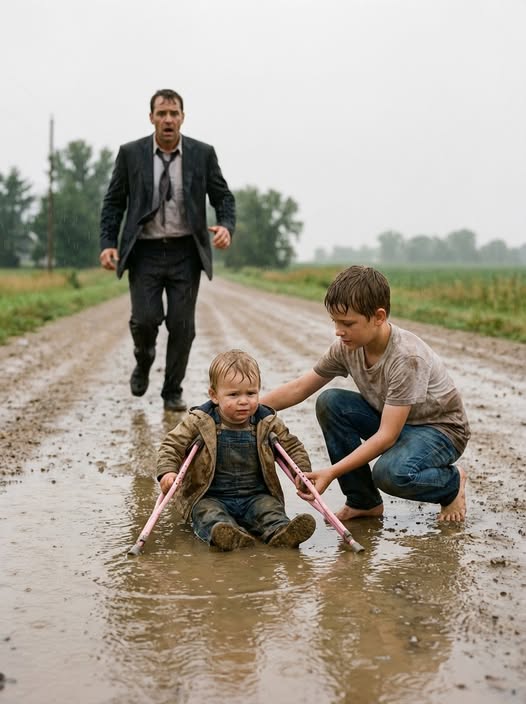
In the center of the driveway, where rainwater had gathered into a wide, muddy pool, Oliver sat soaked to the skin.
His tiny forearm crutches lay abandoned in the water.
His silk pajamas were ruined.
Mud streaked his cheeks.
But Oliver wasn’t crying.
He was laughing.
Loudly. Uncontrollably. Like a child who had just discovered what it meant to be alive.
Beside him knelt another boy—older, barefoot, thin. His hoodie clung to his body, heavy with rain. His pants were rolled up, legs streaked with mud. One arm steadied Oliver, not gripping him, not restraining him—just there.
Jonathan’s breath caught.
“What are you doing?” he shouted, fear sharp in his voice. “Get away from my son!”
The boy looked up calmly.
“He’s okay, sir,” he said. “We’re playing.”
Jonathan stepped into the puddle without thinking. “He can’t play like this. He could get hurt.”
He reached for Oliver.
And froze.
Oliver was pushing himself up.
Hands pressed into the mud. Legs shaking violently. Slipping. Falling.
Laughing harder.
“He can do it,” the boy said softly. “He just needs to try.”
Jonathan stood there, rain streaming down his face, watching something he had never seen before.
Hope.
The Note
“My name’s Lucas,” the boy said. “I sell snacks down the street.”
A small basket lay tipped over nearby, its contents ruined by rain.
“I see your son every day,” Lucas continued. “He watches from the window. Today… he dropped something.”
Lucas pulled a damp piece of paper from his pocket.
Crayon marks. Uneven letters.
Help me go outside.
Jonathan’s chest collapsed inward.
His son hadn’t asked for help to walk.
He had asked for help to live.
Five Minutes That Changed Everything
“Daddy,” Oliver whispered. “Play.”
Jonathan swallowed the scream rising in his throat.
“Five minutes,” he said quietly. “Just five.”
Lucas smiled.
Five minutes became fifteen.
For the first time in two years, Oliver wasn’t a patient.
He was a child in the rain.
The World Pushes Back
The backlash came immediately.
Doctors scolded him.
Oliver’s mother threatened court.
“You let a stranger touch him?” she shouted over the phone. “You risked everything!”
Everyone told Jonathan what he’d done wrong.
No one asked how Oliver felt.
The Blue House
The next day, Jonathan followed Lucas home.
A small blue house. Peeling paint. Warm light.
Inside was Mrs. Evelyn Brooks—Lucas’s grandmother, hands stiff with age, eyes sharp with wisdom.
“Doctors fix bodies,” she said gently. “But children move when they feel joy. Fear freezes them. Play frees them.”
Jonathan listened.
For the first time, he understood.
Learning to Let Go
Lucas came every afternoon.
The house filled with laughter, cushion forts, cardboard tunnels.
Oliver grew stronger—not because he was forced, but because he wanted to move.
Jonathan learned the hardest lesson of his life.
To step back.
To trust.
Standing
Six months after the puddle, Jonathan heard Lucas shout from the garden.
“Mr. Hale! Look!”
Oliver stood.
No braces.
No equipment.
Just legs shaking, holding.
“I’m walking!” Oliver cried.
Jonathan fell to his knees, sobbing.
What Really Matters
Years later, Jonathan stood beside Oliver and Lucas at the opening of a community center built on play, not fear.
“I thought money made me strong,” Jonathan said quietly. “But a barefoot boy taught me otherwise.”
He smiled through tears.
“Sometimes life pushes you into the mud. And that’s where you learn how to stand.”
And somewhere, in the sound of children laughing freely, the quiet windows finally opened.