AnnaMaria
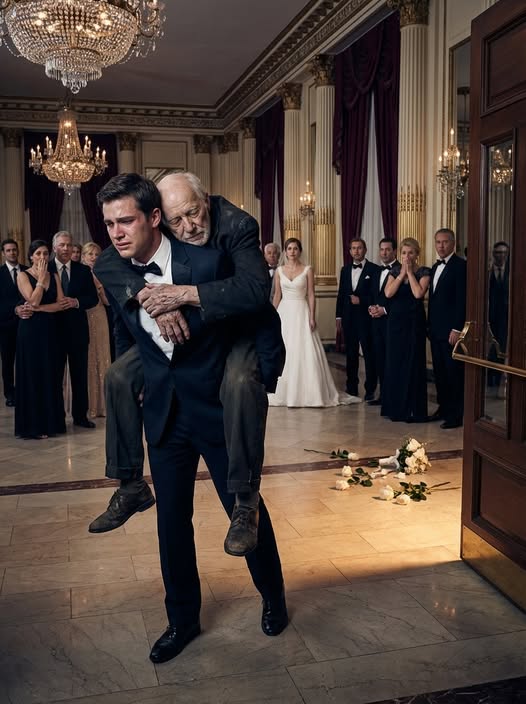
The ballroom of the Silvercrest Hotel in Boston had been designed to intimidate.
Crystal chandeliers hung like frozen constellations from the ceiling, casting soft reflections across polished marble floors that had never known scuffed shoes or hurried steps. White silk tablecloths flowed over tables like still water. Every glass sparkled. Every guest looked as though they belonged on the pages of a luxury magazine.
More than five hundred people were seated that evening. Politicians. Corporate executives. Heirs and heiresses. People who measured worth in net figures and last names.
This was supposed to be the happiest day of my life.
My name is Lucas Bennett. I was thirty-two years old, standing at the altar, about to marry Isabella Rowe — daughter of Richard Rowe, chairman of Rowe Industries, one of the most powerful corporate families on the East Coast.
What happened next didn’t just end a wedding.
It split my life cleanly into before and after.
I noticed my father before the music changed.
Thomas Bennett stood near one of the tall marble columns, just beyond the main seating area, as if he were trying to make himself invisible. He wore a simple dark suit, neatly pressed but clearly old. The fabric had softened with time. His shoes were clean but worn at the edges. Not shabby — just honest.
He looked uncomfortable, shifting his weight slightly, hands clasped in front of him like a man waiting to be told where he was allowed to stand.
I felt my chest tighten.
“Dad,” I said quietly as I walked over, lowering my voice so only he could hear me. “Come stand next to me.”
He hesitated.
“Lucas… it’s fine,” he murmured. “I don’t want to get in the way.”
“You’re not in the way,” I said. “You’re my father.”
He nodded once and took a step forward.
That step echoed across the marble floor louder than it should have. Heads turned. Conversations dipped. Eyes followed him, not with curiosity, but with assessment — the kind that weighs a person and decides quickly whether they belong.
I felt it instantly.
Isabella’s relatives exchanged looks. Subtle smirks. A raised eyebrow here. A tight smile there. It was as if my father’s presence disrupted the visual harmony of the room.
Then I heard laughter.
Not nervous laughter.
Not awkward laughter.
Real laughter.
Andrew Rowe, my new brother-in-law, lifted his champagne glass and spoke loudly enough for half the room to hear.
“That’s your father?” he said, grinning.
“That’s not a father. That’s small-town trash. Look at him — he walks like he’s lost.”
The sound that followed felt like a physical blow.
Not everyone laughed.
But enough did.
Enough to make it hurt in a way I didn’t know how to process.
My ears burned. My hands clenched at my sides. I looked instinctively toward Isabella, waiting — praying — for her to shut it down. For a word. A gesture. Anything.
She covered her mouth for a moment.
Then she laughed too.
Not loudly. Not cruelly, she would later insist.
But she laughed.
She didn’t defend him.
She didn’t stop it.
She said nothing.
Something inside me broke — cleanly, decisively, without drama.
I dropped the bouquet.
The sound of flowers hitting marble was sharper than any shout.
“THIS WEDDING IS OVER,” I said.
My voice carried farther than I expected.
Silence crashed down on the room.
Five hundred people froze.
Isabella stared at me like I had lost my mind. She rushed toward me and slapped me across the face, right there in front of everyone.
“How dare you?” she hissed.
“How dare you humiliate me like this?”
Her father stood up so fast his chair fell backward.
“Get on your knees,” Richard Rowe shouted.
“Apologize right now, or I will destroy you.”
My father’s hand closed around my arm. His fingers trembled.
“Son… please,” he whispered.
“Don’t ruin your future because of me.”
I looked at him.
At the man who worked double shifts when I was a kid.
At the man who fixed neighbors’ cars for free.
At the man who taught me that dignity wasn’t loud — it was consistent.
Then I looked at the Rowes.
Perfect suits. Perfect smiles. Rotten beneath it all.
“You can insult me,” I said calmly.
“But you will never insult my father.”
I turned around and walked out with him.
Behind us were shouting voices. Threats. Broken laughter. Someone yelling about lawyers.
They thought they had just thrown out a nobody.
They had no idea what secret was walking beside me.
The hotel doors closed behind us with a heavy, final sound.
Cold night air hit my face. The city lights blurred as I exhaled for what felt like the first time in hours.
My father leaned heavily on my arm.
“I’m sorry,” I said.
“I shouldn’t have brought you there.”
He shook his head slowly.
“You don’t owe me an apology,” he said.
“I should have told you the truth sooner.”
We got into my old sedan — no driver, no luxury. Just us.
As I pulled onto the quiet street, my chest tightened with something I couldn’t yet name.
“Lucas,” he said carefully,
“All your life, I wanted you to choose people for who they are, not what they own.”
I glanced at him. “What are you talking about?”
He took a deep breath.
“I was never poor,” he said.
I laughed once, sharp and hollow. “Dad, tonight isn’t the time for jokes.”
“I’m not joking.”
I stopped at a red light and looked at him fully.
“I am the founder of Northway Logistics Group.”
My foot nearly slipped off the brake.
Northway Logistics Group wasn’t just successful.
It was massive.
International shipping. Freight corridors. Government contracts. A name that carried weight in rooms where decisions were made quietly and powerfully.
“I sold daily control years ago,” he continued.
“But I remain the majority shareholder. Everything is in my name… and yours.”
The world tilted.
“Why didn’t you ever tell me?” I whispered.
“Because I wanted you to know yourself before money could interfere,” he said.
“And tonight, I found out who you are.”
The next morning, the internet exploded.
Videos from the wedding flooded social media. Headlines screamed about the collapse. The Rowe family’s PR machine kicked in immediately, painting me as unstable, resentful, ungrateful.
Then the truth surfaced.
An official statement confirmed my father’s identity.
Markets reacted instantly.
Rowe Industries’ stock dipped. Partners paused contracts. Investors grew nervous.
Richard Rowe called me twenty-three times in two days.
I didn’t answer.
Isabella showed up at my apartment three days later, eyes red, makeup smeared.
“I didn’t know,” she said.
“If I had known who your father was—”
I stopped her.
“That’s exactly the problem,” I said quietly.
“It only mattered once there was money.”
She left without another word.
Weeks passed.
Northway Logistics acquired a strategic stake in one of Rowe Industries’ primary competitors.
It was legal.
Clean.
Unavoidable.
It wasn’t revenge.
It was consequence.
But the biggest change didn’t happen in boardrooms.
It happened inside me.
I didn’t rush into an executive role. Instead, I went where my father had always gone.
Warehouses. Loading docks. Dispatch offices.
I listened.
I learned names. Stories. Frustrations. Quiet dignity.
We launched an internal program called The Dignity Line — a system that allowed workers to report mistreatment without fear.
Executives resisted. Some resigned. Others adapted.
My father watched quietly from a distance.
“You’re ready now,” he told me months later.
One evening, we walked through the city together, unnoticed.
“I spent my life pretending to be small to protect you,” he said.
“Now I know it was worth it.”
I hugged him.
I lost a wedding in front of five hundred people.
I lost a powerful family.
But I gained something far greater.
My identity.
My principles.
And a father whose worth had nothing to do with what he owned — and everything to do with who he was.
Sometimes, the greatest public humiliation becomes the doorway to the most honest life you’ll ever live.
And sometimes, silence isn’t weakness.