AnnaMaria
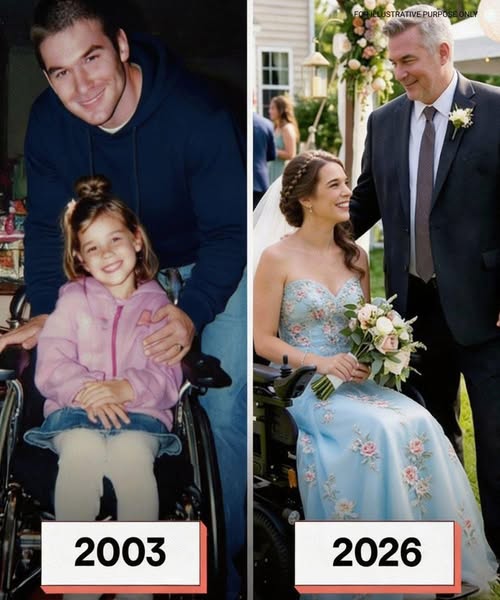
who needed saving. I saw a child who needed someone to stay.
The adoption process was slow. There were evaluations, home visits, paperwork that seemed endless. I visited Lily every chance I had. We talked about animals, about clouds, about the notebook she carried everywhere. She told me she liked owls because they “see things other people miss.” That sentence stayed with me long after.
The day I brought her home, she arrived with a backpack, a stuffed owl, and that notebook. She looked around the house quietly, memorizing it. That night, as I folded laundry, she rolled into the doorway and asked, very casually, if she could have more juice.
She called me Dad without hesitation, without ceremony.
I cried in the laundry room where she couldn’t see me.
Life became full again — not easy, but meaningful. Therapy appointments replaced loneliness. Progress came slowly, then suddenly. Lily worked harder than anyone I had ever known. Every step she took with braces felt like a victory earned through sheer determination.
School was challenging. Children can be unkind when they don’t understand. Lily learned early to set boundaries, to demand respect, and to refuse pity. She grew sharp, thoughtful, and quietly resilient.
She loved science. Biology fascinated her — the way bodies healed, adapted, survived. She volunteered at a wildlife center in high school and bonded with an injured barn owl they were rehabilitating. The day it was released, she cried openly, unashamed.
She grew into a woman I admired deeply.
At twenty-five, she introduced me to Ethan. He was gentle, attentive, never rushed. He didn’t see Lily as fragile or strong — he saw her as complete. I watched him carefully, not suspiciously, but protectively. He passed every test without knowing there were tests.
When Lily told me they were engaged, I felt something loosen inside me — a joy I hadn’t expected to feel again.
The wedding was small, personal, full of warmth. Lily walked down the aisle confidently, her dress simple and elegant, her smile steady. I stood beside her, overwhelmed by pride and gratitude.
And then, as the evening settled into celebration, I noticed a woman standing near the exit.
She wasn’t watching the crowd. She was watching Lily.
She approached me quietly and asked if we could speak privately. Her voice trembled, though she tried to control it.
“You have no idea what your daughter is hiding from you,” she said.
She told me she was Lily’s biological mother.
She explained that Lily had found her two years earlier. They had talked. She had explained why she left — fear, shame, helplessness in the face of disability and grief. She said Lily had stopped replying months ago, but she knew about the wedding.
I listened calmly. I didn’t feel anger. I didn’t feel threatened.
“This day isn’t about biology,” I told her. “It’s about who stayed.”
She nodded, eyes wet, and left without argument.
Later, outside under the string lights, Lily stood beside me.
“She came, didn’t she?” she asked.
“She did,” I said honestly.
“I needed to meet her,” Lily said. “To understand. And to walk away.”
I took her hand and told her what I had always believed but had never needed to say out loud: that family isn’t defined by blood or absence, but by presence and choice, repeated every day.
She smiled through tears and thanked me — not for adopting her, but for staying.
As I watched her dance with Ethan later that night, I realized something that took decades to learn.
Love isn’t proven by perfection or by erasing the past. It’s proven by consistency, by showing up again and again, even when it’s hard, even when no one is watching.
Some truths are hidden not to deceive, but to protect love from unnecessary pain. And when they finally surface, they don’t break families — they reveal how strong those families already are.
I didn’t lose a daughter that night.
I gained a deeper understanding of the one I raised — and the quiet courage she carried all along.