AnnaMaria
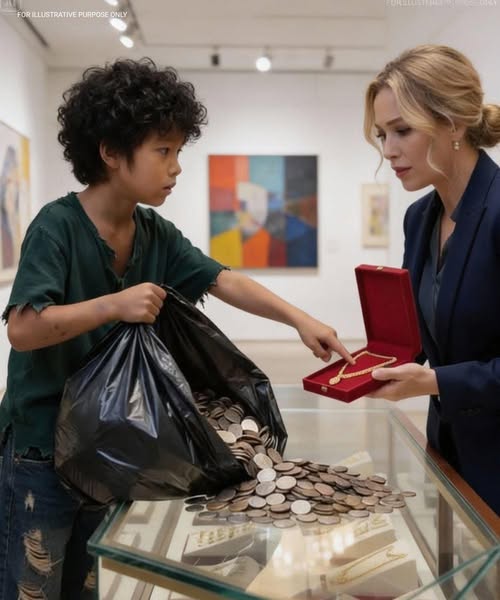
welry store was one of the most upscale in the district. Marble floors gleamed under warm lighting. Velvet trays displayed gold chains and diamond rings that cost more than most families earned in a year. Customers spoke in hushed tones, discussing investments, anniversaries, insurance appraisals, and legal documentation for heirlooms that would pass through generations.
And then there was the boy.
His clothes were thin and worn, too big in some places and too small in others. His sandals were cracked at the edges. His hair stuck out in uneven clumps, and there was dust on his knees, the kind that doesn’t come from playgrounds but from streets.
He didn’t look around in awe. He didn’t touch anything. He walked straight to the glass counter, stood on his toes, and quietly lifted a small cloth sack.
Then he turned it upside down.
When Money Makes a Different Sound
Coins spilled across the counter in a metallic cascade.
Not a handful. Not a few pesos. Hundreds of coins. Thousands. They rolled and clinked, spreading across the pristine glass like a tide of dull silver and bronze.
The sound cut through the store.
Conversation stopped mid-sentence. A woman examining a diamond bracelet froze, her hand still hovering. A man discussing a luxury insurance rider frowned openly. A couple near the back exchanged looks that mixed irritation and disbelief.
This was not how money was supposed to sound here.
This was not how customers were supposed to look.
A security guard near the entrance stiffened. His hand moved instinctively toward his baton as his eyes locked onto the boy. He took a step forward, already preparing the words he had said too many times before.
“Hey. You can’t—”
Before he could finish, the boy spoke.
Words That Didn’t Match His Shoes
“Yes, ma’am,” the boy said, his voice soft but steady. “It’s 5,250 pesos altogether. I counted it last night. Three times.”
The guard stopped mid-step.
The store manager, Ms. Carla, who had been reviewing a transaction at the register, looked up sharply.
The boy’s words didn’t carry fear. They didn’t beg. They didn’t rush. They landed with quiet certainty, the kind that comes from effort, not entitlement.
Ms. Carla walked closer, her heels clicking against the marble floor.
“You counted it?” she asked, studying him.
“Yes, ma’am,” the boy replied. “I didn’t want to make a mistake.”
A Different Kind of Financial Statement
The manager glanced at the spread of coins. It would take time to verify the amount. In a store accustomed to electronic transfers, certified checks, and finance-backed purchases, this was an inconvenience.
But something about the boy’s posture made her pause.
“Where did you get this much money?” she asked.
The boy lowered his eyes. He wiped his nose with the edge of his sleeve, embarrassed but not ashamed.
“I collect recyclables,” he said. “Plastic bottles. Old newspapers. Scrap metal. Sometimes cardboard. I sell them by weight.”
He hesitated, then added, “I saved for one year.”
The room was quiet now.
No one pretended to browse anymore.
The Necklace That Wasn’t Just Jewelry
The boy looked up again, his eyes shining, not with greed, but with something dangerously close to hope.
“My mom pawned her necklace when I got dengue last year,” he said. “We didn’t have money for medicine. Or hospital fees. No insurance. No savings.”
A few customers shifted uncomfortably. Words like medical debt and healthcare costs hung invisibly in the air.
“She cried when she gave it to the pawnshop,” the boy continued. “It was from my grandmother. She said it was the only thing she had left from her.”
He swallowed hard.
“I promised her that when I got better, I’d buy it back. Tomorrow is her birthday.”
The coins on the counter suddenly felt heavier than gold.
When Wealth Has Nothing to Say
No one spoke.
The woman with the diamond bracelet lowered her hand. The man who had been discussing asset protection cleared his throat and looked away. The security guard’s grip loosened. His shoulders sagged.
Ms. Carla felt her chest tighten.
In her years managing the store, she had seen everything. People arguing over inheritance clauses. Couples fighting about prenuptial agreements. Clients insuring jewelry worth more than entire neighborhoods.
But this?
This was different.
She nodded slowly. “Wait here,” she said.
The boy stood perfectly still, his hands clenched together as if movement might break something fragile.
What the Vault Held — And What It Didn’t
Ms. Carla walked to the back, past the vault that protected items appraised, insured, and cataloged down to the gram.
She retrieved the necklace.
It wasn’t extravagant. No diamonds. No designer branding. Just a simple gold chain with a small locket, worn smooth by years of touch.
She imagined the hands that had held it before. A grandmother. A mother. A child.
When she returned, she placed the necklace gently on the counter.
The boy’s breath caught.
A Transaction That Broke the Rules
Ms. Carla took the pawn ticket, examined it, and then did something no one expected.
She placed the ticket into the boy’s hand.
Then she set the necklace inside a red velvet box and pushed it toward him.
“My child,” she said, her voice trembling despite her effort to keep it professional, “this belongs with your family.”
The boy immediately pushed the coins forward.
“This is my payment,” he said quickly. “I worked for it.”
She placed her hand over his, stopping the movement.
“No,” she said softly. “This one is free.”
The word echoed.
Free.
In a store where nothing was ever free.
When Profit Steps Aside
The boy’s mouth fell open.
“W-What?” he whispered.
“This is my gift to your mother,” Ms. Carla said. “And to you. For being a good son.”
Tears blurred the boy’s vision. He tried to speak, failed, then tried again.
“But—”
She gently gathered the coins back into the cloth sack, every single one.
“Keep your money,” she said. “Buy her a cake. Buy food. Make tomorrow special.”
The boy broke down completely.
A Walk That Felt Taller Than Any Crown
As he left the store, clutching the velvet box and the bag of coins, no one stopped him.
No one stared.
They watched him go in silence.
He didn’t walk out like a beggar.
He walked out like someone who had paid with something far rarer than cash.
What Changed Inside That Store
For the rest of the day, transactions continued. Jewelry was sold. Appraisals were signed. Legal paperwork was completed. Insurance policies were discussed.
But something had shifted.
Customers spoke a little softer. The security guard stood a little straighter. Ms. Carla found herself distracted, replaying the boy’s words again and again.
In a business built on wealth management, luxury assets, and financial valuation, everyone had been reminded of something the spreadsheets never show.
The Real Delivery Happened at Home
The next day, in a small, tin-roofed home at the edge of the city, the boy placed the red velvet box into his mother’s hands.
She opened it.
Her breath left her in a single, broken sound.
The necklace.
The same one she had surrendered in desperation to save her child’s life.
“How did you—” she began.
He answered by wrapping his arms around her.
That night, there was a simple cake. Flickering candles. Laughter that didn’t need money to feel rich.
The Lesson No Appraisal Can Measure
Luxury stores sell beauty. Pawnshops trade in necessity. Banks manage risk. Insurance protects value.
But love?
Love doesn’t depreciate.
Love doesn’t need collateral.
Love doesn’t clink when it lands on a counter.
It changes rooms.
It changes people.
It changes what we think wealth even means