AnnaMaria
The Wedding Designed to Impress the World
The hacienda was dressed in white, the kind of white that signals wealth before a single word is spoken. In the main garden of Hacienda San Ángel, in the south of Mexico City, an ivory carpet stretched across the freshly cut grass, appearing to float rather than rest. Imported flowers arched overhead, crystals hung like frozen drops of light, and an orchestra waited with polished instruments, prepared to play an instrumental version of “Las Mañanitas.” In this family, even emotion was expected to look refined.
Ricardo Herrera stood at the altar with the practiced confidence of a man accustomed to admiration. He was a businessman whose name appeared regularly in finance magazines beside phrases like “visionary leader,” “strategic philanthropist,” and “market disruptor.” His posture was flawless, his expression composed, his image carefully protected by years of legal advisors, public relations teams, and well-funded silence.
To his right stood Valeria Montoya, his fiancée. Her dress cost more than many people’s homes, custom-made, fitted with precision, flawless from every angle. She radiated perfection, or at least the version that photographs well. From a distance, she looked like the embodiment of success: elegant, controlled, untouchable.
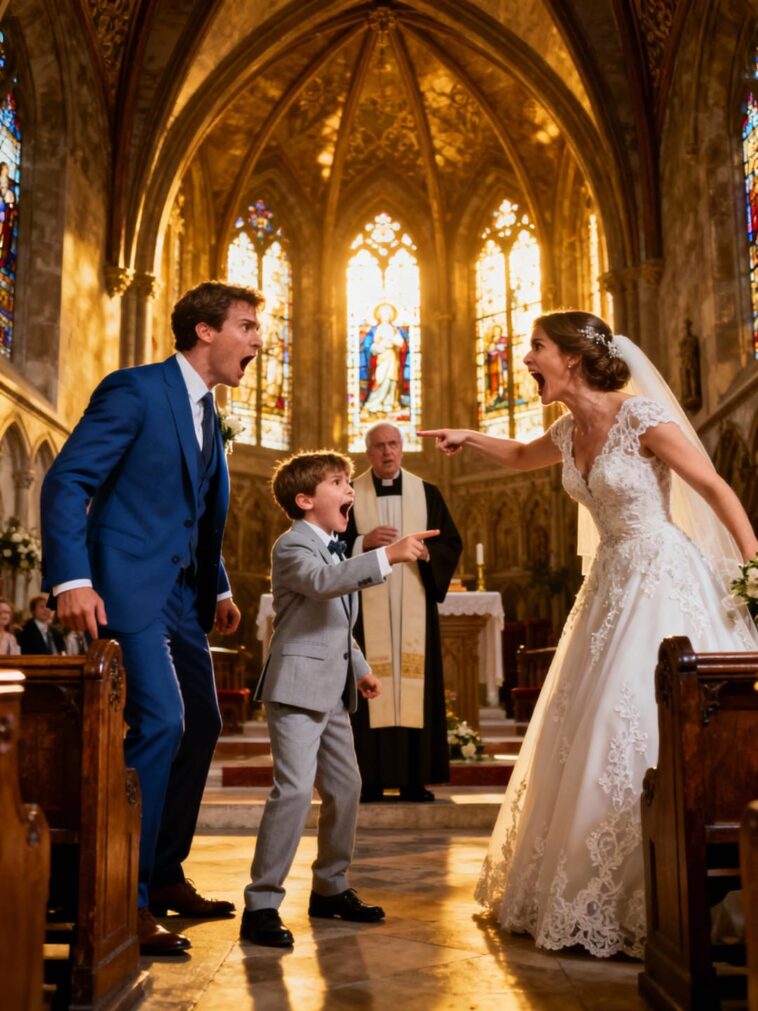
And in front of them, almost swallowed by the grandeur of flowers and silk, stood an eight-year-old boy in a gray suit with a blue bow tie. His hands were clenched deep inside his pockets, fists tight enough to whiten his knuckles. His name was Diego Herrera. Ricardo’s son. The child everyone described as “quiet,” “sensitive,” “shy.” The child people said barely spoke.
As the guests settled, Diego’s heart pounded with a single, relentless thought.
If I don’t speak today, no one will ever listen to me.
The Sentence That Changed the Air
The officiant lifted his gaze, smiled warmly at the assembled guests, and spoke the sentence that always sounds ceremonial until it suddenly doesn’t.
“If anyone present objects to this union, speak now or forever hold your peace.”
The silence that followed felt heavy, almost ceremonial itself. Politicians shifted in their chairs. Business partners adjusted their cuffs. Phones hovered discreetly behind programs, ready to capture perfection.
Then, from the center of the altar, a small voice cut through the stillness.
“I object.”
The orchestra froze mid-breath. A champagne glass slipped from someone’s hand and shattered softly against the stone floor, the sound embarrassingly loud in the sudden quiet.
Diego stepped forward.
His face was flushed, his chest rising and falling too fast. In his hand, he held a cellphone, gripping it like a shield. Not a toy. Not a game. Something chosen deliberately.
“Dad,” he said, staring straight at Ricardo. “If I don’t say this right now… no one will ever believe me.”
The Smile That Slipped Too Fast
Valeria let out a light, nervous laugh, the kind used to redirect attention when a moment goes off script.
“Oh, what a silly idea,” she said sweetly. “He’s just restless. Children get overwhelmed, don’t they?”
Her lips curved upward, but her eyes didn’t follow. In them flickered something sharper: irritation, fear, calculation.
Ricardo stood frozen. He didn’t know whether to pull his son into an embrace or apologize to the guests. His jaw tightened, grinding against a familiar guilt he had learned to swallow.
“Diego,” he murmured. “What are you talking about?”
The boy swallowed hard. Guests leaned forward. Phones rose higher. This was no longer a wedding. It was becoming something else entirely.
“This isn’t a game,” Diego said, his voice trembling but firm. “I have proof.”
When the Altar Becomes a Courtroom
The officiant opened his mouth, then closed it again. There was no protocol for this. No training manual for a child who turned a luxury wedding into a trial.
Valeria stepped toward Diego, gripping her bouquet tighter.
“This isn’t the place,” she said, her tone sharper now. “These are children’s matters. Step down, sweetheart.”
Diego looked at her. And for the first time, he wasn’t afraid.
“That’s exactly how you make me feel,” he said quietly. “Afraid. Ashamed. Like I’m in the way.”
A ripple of murmurs moved through the chairs.
Diego raised the phone with shaking hands and pressed play.
The Voice No One Was Meant to Hear
The sound came through the speakers, clear and unmistakable.
“Stop crying. Don’t ruin my photos. If you mention your mother again, you’ll be punished. Do you understand?”
Valeria’s voice. Cold. Controlled. Certain.
The garden seemed to lose oxygen.
Valeria lunged toward the speakers, her composure cracking. “That’s fake!” she shouted. “Someone manipulated it!”
In the back row, a young woman in a modest dress covered her mouth. Sofía Aguilar, the nanny. Her eyes shone not with surprise, but with relief. She knew that voice. She knew the punishments. She knew the boy who learned to swallow his tears so he wouldn’t “cause problems.”
Diego didn’t stop.
The Words That Explained Everything
He pressed play again.
“Your mom is dead. Get over it. I’m the one in charge here.”
Someone whispered a prayer. An older woman crossed herself. The orchestra members stared at the ground.
Ricardo felt his stomach turn to stone. He looked at Valeria as if seeing her without makeup, without rehearsed kindness, without the illusion he had chosen not to question.
Diego’s voice grew steadier, as if each sentence gave him strength.
“She said those things when you weren’t around,” he said. “And when I tried to talk to you, she told me not to bother you. That you had important things to do. So I stayed quiet.”
Ricardo closed his eyes.
He didn’t need the rest. He already knew how often he had chosen work over discomfort, absence over confrontation, silence over responsibility.
The Recording No One Expected
Valeria lifted her chin, desperate to regain control.
“Ricardo, please,” she said. “He’s a child. He imagines things. Look at the scene he’s making.”
Diego opened a folder on the phone. His finger hovered for a moment.
“I also recorded when they talked about me,” he said.
Valeria’s voice played again, joined by another woman’s. Carmen Montoya. Her mother.
“Once he signs, it’s settled. The boy goes to a boarding school. Anxiety is justification enough. The press will accept it. You keep everything, and we get our share.”
The silence that followed wasn’t shock.
It was horror.
When Power Breaks in Public
Ricardo staggered back as if struck.
“Boarding school?” he whispered.
Valeria reached for Diego, but Sofía stepped forward instantly, placing herself between them.
“Don’t touch him,” Sofía said, her voice trembling but unwavering.
Valeria turned on her, venom sharp in her eyes.
“You filled his head with lies.”
Sofía didn’t flinch. “I told him he wasn’t alone.”
Ricardo raised his hand, not to strike, not to silence, but to stop everything.
“It’s over,” he said. His voice carried farther than the orchestra ever could. “The wedding is over.”
Gasps rippled through the crowd, but Ricardo didn’t look at them. He knelt on the expensive carpet, right in front of his son.
The Apology That Mattered
“Forgive me,” Ricardo said. “For not seeing you. For not listening. For leaving you alone.”
Diego trembled. Then he spoke.
“I just wanted you to hug me without being told I was in the way.”
Ricardo wrapped his arms around him, holding him as if trying to reclaim years in seconds. Diego cried openly, without fear, without shame.
Security escorted Valeria and Carmen away amid shouting, threats, and legal promises. None of it mattered anymore.
Ricardo’s lawyer, Arturo Salgado, approached calmly.
“We need to activate protective measures,” he said. “Restraining orders. Reports. And the digital evidence should be secured.”
Diego lifted the phone slightly.
“It’s already backed up,” he said.
That sentence sounded like freedom.
What Remained After the Guests Left
There was no reception. No toast. No waltz. But something new filled the space where spectacle had been.
Truth.
The days that followed were brutal. Media inquiries. Business partners wanting damage control. Legal advisors suggesting silence. Ricardo chose differently.
He moved Diego to a smaller home. Quiet. Safe. He placed photos of Mariana, Diego’s mother, throughout the house, not as mourning, but as presence. He enrolled Diego in therapy and attended every session himself. No excuses.
Sofía stayed, no longer just an employee, but a pillar of stability. Ricardo offered her a formal contract, benefits, and something rarer.
Respect.
“I’m not asking you to fix what I broke,” he told her. “Just help me learn.”
The Life That Slowly Rebuilt Itself
Healing didn’t happen quickly. Trust doesn’t regenerate on command. But small things changed.
Ricardo arrived on time for school events. He learned to cook pancakes and burned them, laughing instead of hiding behind assistants. Diego began to draw again, no longer afraid of being corrected or shamed.
A year later, instead of a lavish anniversary, Diego celebrated his ninth birthday in the living room. Chocolate cake. Balloons. A crooked piñata he insisted on painting himself. It read COURAGE.
Ricardo raised his soda.
“To my son,” he said. “The bravest person in that hacienda.”
Diego shook his head.
“I didn’t want to be brave,” he said. “I just wanted to be okay.”
Ricardo squeezed his hand.
“And you will be. I promise.”
Diego smiled fully, without permission.
When Silence Finally Breaks
Life didn’t give Diego a perfect wedding.
It gave him something better.
An awakened father.
A safe home.
And the knowledge that speaking the truth can break even the oldest silence.
Sometimes courage isn’t loud. Sometimes it’s small, shaking, and eight years old.